
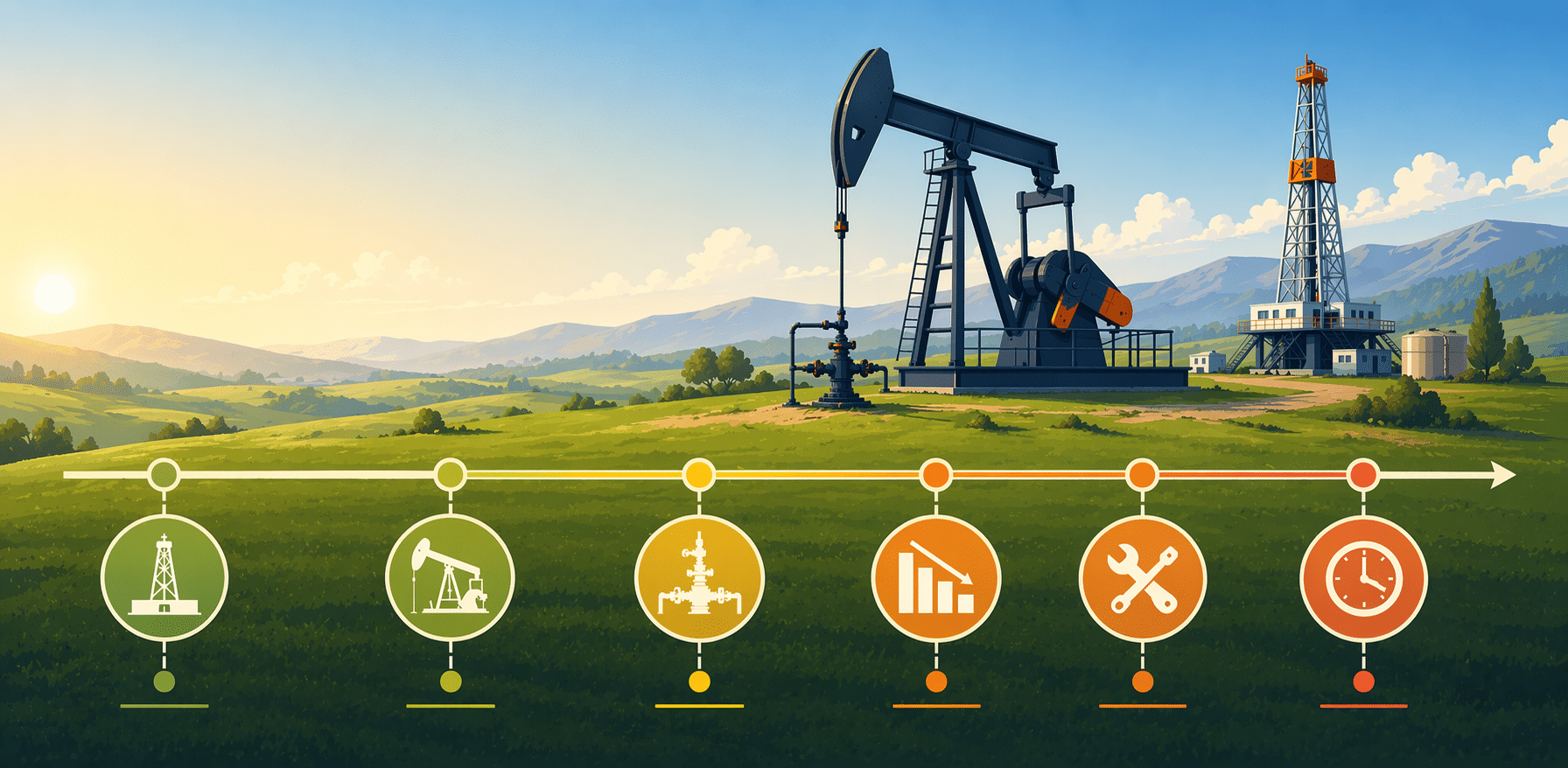
When evaluating energy production, one of the most common and important questions is: how long do oil and gas wells last? The answer is not fixed. Some wells produce for only a few years, while others continue generating output for decades. The wide variation in lifespan is driven by a combination of geological characteristics, engineering decisions, operational practices, and economic conditions.
Understanding how long do oil and gas wells last requires looking beyond a simple timeframe and instead examining the full lifecycle of a well. By breaking down each stage of production and exploring the factors affecting oil and gas well lifespan, it becomes much easier to understand why some wells decline quickly while others remain productive for extended periods.
The information provided on this page is for general informational purposes only and does not constitute legal, financial, or investment advice. Oil and gas laws, mineral rights regulations, and royalty structures vary significantly by state and jurisdiction. While we strive to provide accurate and up-to-date information, no guarantee is made to that effect, and laws may have changed since publication. You should consult with a licensed attorney specializing in oil and gas law in your jurisdiction, a qualified financial advisor, or other appropriate professionals before making any decisions based on this material. Neither the author nor the publisher assumes any liability for actions taken in reliance upon the information contained herein.
Key Takeaways
- The answer to how long do oil and gas wells last typically ranges from 5 to over 40 years.
- Most wells experience rapid early production followed by a long decline period.
- Economic conditions often determine when production stops.
- Factors affecting oil and gas well lifespan include geology, engineering, and cost structure.
- All wells must eventually undergo oil well plugging and abandonment.
- Abandoned and orphan well regulations ensure wells are safely retired.
The Lifecycle of an Oil and Gas Well
To fully understand how long do oil and gas wells last, it is essential to break the process into its lifecycle stages. Each stage contributes to the overall duration of production and plays a role in determining how long a well remains active.
Exploration and Drilling
The lifecycle begins with geological surveys and seismic analysis. These tools help identify potential hydrocarbon reservoirs beneath the surface. Once a viable formation is identified, drilling begins. Wells may be drilled vertically or horizontally depending on the target formation.
Horizontal drilling has significantly improved the ability to extract hydrocarbons, particularly in shale formations. By extending laterally through the reservoir, operators can access more resource with a single well, often increasing both initial production and total recovery.
Completion and Early Production
After drilling, the well is completed. This involves installing casing, perforating the wellbore, and often applying hydraulic fracturing to improve flow in low-permeability formations. Once completed, the well begins producing.
Production typically increases rapidly during the early phase. This initial surge is critical, as a significant portion of total production often occurs within the first few years.
To understand how production varies across wells, see average natural gas well production.
Peak Production Phase
Most wells reach peak production relatively early. In shale wells, this may occur within months, while conventional wells may reach peak output more gradually. Peak production is a key determinant of total well performance and revenue potential.
Decline Phase and Production Behavior
After peak output, wells enter the decline phase. Production decreases over time due to falling reservoir pressure and reduced flow efficiency. Decline rates vary widely depending on the formation.
For example, shale wells often decline sharply, sometimes losing 60% or more of their production within the first year. In contrast, conventional wells tend to decline more gradually, allowing them to remain productive for longer periods.
This stage represents the longest portion of a well’s life and is central to understanding how long do oil and gas wells last.
Late-Life Production
In later years, wells produce at lower volumes. However, they may continue operating for extended periods if operating costs remain low enough. Operators may implement artificial lift systems, such as pumpjacks or gas lift, to maintain production.
If you are analyzing long-term well performance challenges, you can contact our team for additional insights.
End of Life and Decommissioning
Eventually, production declines to a level where it is no longer economically viable. At this stage, the well is shut in and prepared for closure. This marks the end of its productive life.
Factors Affecting Oil and Gas Well Lifespan
A wide range of variables influence how long do oil and gas wells last. These factors affecting oil and gas well lifespan can vary significantly between wells, even within the same region.
Reservoir Quality
The quality of the reservoir plays a major role in determining lifespan. High porosity allows the rock to store more hydrocarbons, while high permeability allows those hydrocarbons to flow more easily.
Reservoir pressure is another critical factor. Higher pressure helps drive hydrocarbons to the surface, supporting longer production periods.
Technology and Engineering
Advancements in drilling and completion technology have extended the lifespan of many wells. Horizontal drilling, multi-stage fracturing, and improved materials all contribute to better performance and longer production timelines.
Operational Efficiency
Regular maintenance, monitoring, and optimization strategies can extend the life of a well. Workovers, recompletions, and equipment upgrades are commonly used to maintain production levels.
Commodity Prices
Market conditions have a direct impact on how long do oil and gas wells last. When prices are high, operators are more likely to continue producing even at lower output levels.
To better understand financial performance, see how much money you can make from an oil well.
Operating Costs
As wells age, operating costs often increase. Maintenance, equipment replacement, and inefficiencies all contribute to higher expenses. When costs exceed revenue, wells are typically shut in.
Economic vs Physical Lifespan
A well’s physical lifespan refers to how long it can technically produce hydrocarbons. Its economic lifespan refers to how long it remains profitable. In many cases, wells are shut down before they are fully depleted because production is no longer economically viable.
Decline Curves in Practice
Production Timeline Example: How Output Changes Over Time
To better understand how long do oil and gas wells last, it helps to look at a simplified production timeline. While every well is different, many follow a similar pattern when viewed over time.
In the first year, production is typically at its highest. A shale well, for example, may begin producing hundreds or even thousands of barrels per day shortly after completion. However, this initial surge is usually followed by a steep decline. By the end of the first year, production may fall by 50% or more, depending on reservoir conditions and completion design.
Between years two and five, the decline rate often begins to stabilize. Production continues to decrease, but at a slower and more predictable pace. During this period, operators may perform maintenance work or minor interventions to optimize performance and extend the productive life of the well.
From years five through fifteen, the well typically enters a long tail phase. Production volumes are significantly lower than initial levels, but the well may still generate consistent output. This stage is particularly important when evaluating factors affecting oil and gas well lifespan, as operating costs and commodity prices play a larger role in determining whether production continues.
Beyond fifteen years, some wells continue producing at marginal levels. These wells may only generate small amounts of oil or gas each day, but they can remain active if operating costs are minimal. In conventional reservoirs, this phase can extend for decades, contributing to the longer lifespan often associated with these wells.
This timeline highlights a key point: the question of how long do oil and gas wells last is not just about total years of operation, but also about how production changes throughout the life of the well. Early production drives much of the total output, while later years often depend on efficiency and cost control.
Regulatory Costs and Long-Term Environmental Considerations
In addition to technical and economic factors, regulatory requirements play a major role in determining how long do oil and gas wells last. Operators must comply with strict rules governing safety, environmental protection, and well closure.
The cost of oil well plugging and abandonment can vary widely depending on depth, location, and well condition. In some cases, plugging a single well can cost tens of thousands of dollars or more. These costs must be planned for in advance and are often required to be secured through bonds or financial assurances.
Abandoned and orphan well regulations are particularly important in this context. Regulators require operators to properly close wells at the end of their life to prevent environmental damage. If an operator is unable to fulfill these obligations, the well may become orphaned and fall under government responsibility.
Environmental considerations, including groundwater protection and methane emissions, have become increasingly important in recent years. As a result, regulatory frameworks continue to evolve, influencing how operators manage wells throughout their lifecycle and ultimately impacting the total duration of production.
Decline curves are used to model production over time. These curves help operators forecast output and estimate total recovery. Exponential, hyperbolic, and harmonic models are commonly used to represent production behavior.
For example, a shale well may start at 1,000 barrels per day, decline to 400 barrels per day within the first year, and continue declining gradually over time. These patterns play a major role in determining factors affecting oil and gas well lifespan.
Enhanced Oil Recovery and Lifespan Extension
Enhanced oil recovery (EOR) techniques are used to extend the life of wells and increase total recovery. These methods are particularly useful in mature fields where primary production has declined.
- Water flooding helps maintain reservoir pressure.
- Gas injection improves hydrocarbon flow.
- Chemical injection reduces viscosity and enhances recovery.
These techniques can significantly extend production timelines and improve overall well performance.
Cost Lifecycle of a Well
The cost structure of a well evolves over time. Early in the lifecycle, costs are dominated by drilling and completion. As the well matures, operating and maintenance costs become more significant.
This shift in cost structure is a major factor in determining when production stops and is closely tied to how long do oil and gas wells last.
Oil Well Plugging and Abandonment
When a well reaches the end of its life, it must undergo oil well plugging and abandonment. This process involves sealing the well with cement to prevent fluid migration and protect groundwater resources.
Proper abandonment is essential for environmental safety and is required by regulatory agencies.
Abandoned and Orphan Well Regulations
Abandoned and orphan well regulations ensure that inactive wells are properly managed. State and federal agencies require operators to plug wells and restore sites after production ends.
Orphan wells, which lack responsible operators, are typically addressed through government-funded programs focused on remediation and environmental protection.
Real-World Lifespan Examples
- Shale wells: 10–20 years with steep decline
- Conventional wells: 20–40+ years with steady production
- Offshore wells: Can operate for multiple decades
What Causes Wells to Shut In Early?
Wells may stop producing earlier than expected due to:
- Low commodity prices
- High operating costs
- Mechanical issues
- Reservoir depletion
Why Well Lifespan Matters
Understanding how long do oil and gas wells last is important for evaluating production trends, forecasting output, and managing resources effectively. It also provides insight into how the industry balances production with environmental responsibility.
Conclusion
Ultimately, how long do oil and gas wells last depends on a complex interaction of geology, engineering, economics, and regulation. Some wells produce for only a few years, while others continue operating for decades.
From early production through decline and eventual oil well plugging and abandonment, each stage contributes to the overall lifecycle. Understanding these dynamics—and the factors affecting oil and gas well lifespan—provides valuable insight into how energy resources are developed and managed.
To learn more or explore specific opportunities, contact our team today.