
Tag Archive for: usoil

U.S. stocks moved higher on Monday, supported by gains in energy companies and major banks. The S&P 500 added 0.6% to 6,902.05, the Dow Jones Industrial Average climbed 1.2% to a record 48,977.18, and the Nasdaq rose 0.7% to 23,395.82. Smaller-company stocks also advanced, with the Russell 2000 up 1.6%, while European markets generally increased as well.

Energy stocks strengthened after U.S. forces captured Venezuelan President Nicolás Maduro in a weekend operation, drawing renewed attention to the country’s oil sector. U.S. crude rose 1.7% to $58.32 a barrel and Brent gained 1.7% to $61.76. Chevron jumped 5.1%, Exxon Mobil rose 2.2%, and Halliburton gained 7.8% after President Donald Trump discussed a plan for U.S. oil companies to help rebuild Venezuela’s industry, where output is currently around 1.1 million barrels per day and could rise with investment.

Investors also tracked moves in other markets and upcoming economic reports. Gold rose 2.8%, silver gained 7.9%, and bitcoin traded near $94,700. Treasury yields eased, with the 10-year at 4.15%. This week’s calendar includes data on services activity and jobs that could influence expectations for Federal Reserve policy; markets have been anticipating the Fed will keep rates unchanged at its meeting later in January.

Source: AP News
Read the full original article here
Ranger Land & Minerals curates weekly insights from across the oil and gas industry to keep our readers informed. To receive news like this directly in your inbox, join our free newsletter. If you’d like to learn more about mineral rights and oil royalty opportunities, contact us to speak with a representative.
DISCLAIMER: The summary above is based on information from third-party sources believed to be reliable, but its accuracy and completeness cannot be guaranteed. It is provided for general informational purposes only and does not constitute investment, financial, tax, legal, or other professional advice, nor a recommendation or solicitation to buy or sell any security, commodity, or investment product. Markets, regulations, and circumstances can change, and the information may not reflect the most current developments. You should conduct your own research and consult a qualified financial advisor, CPA, or other professional before making decisions based on this content. The publisher and its affiliates disclaim any liability for losses or damages arising from reliance on the information provided above.

An opinion column from Tracee Bentley, president and CEO of the Permian Strategic Partnership (PSP), argues that sustaining Permian Basin growth depends on continued investment in the southeast New Mexico communities that support energy development. Bentley writes that if the Permian Basin were a country, it would rank among the world’s top oil producers, and that the region could account for 50% of U.S. oil production by 2030. She says energy companies formed the PSP to collaborate on regional priorities, reporting more than $214 million in direct spending over six years and over $2.3 billion in leveraged collaborative investments.

The piece focuses on workforce development and public services needed to support long-term activity, citing an estimated need for nearly 186,000 additional workers by 2040. Bentley highlights PSP support for career and technical programs in Hobbs, Artesia, and at Southeast New Mexico College, including $15 million in funding this year. She also points to expanded commercial driver training at New Mexico Junior College (with an estimated need for 7,000 new drivers by 2040), regional first-responder training with Eddy County Fire and Rescue, and a $325,000 investment for five cardiac monitors for Carlsbad Fire Department units. Bentley adds that the Permian region represents 9.2% of New Mexico’s population but produces 25.9% of the state’s private-sector GDP, framing these efforts as support for a durable economic base tied to the Permian Basin and ongoing oil and gas royalties.

Source: Albuquerque Journal
Read the full original article here

Ranger Land & Minerals curates weekly insights from across the oil and gas industry to keep our readers informed. To receive news like this directly in your inbox, join our free newsletter. If you’d like to learn more about mineral rights and oil royalty opportunities, contact us to speak with a representative.
DISCLAIMER: The summary above is based on information from third-party sources believed to be reliable, but its accuracy and completeness cannot be guaranteed. It is provided for general informational purposes only and does not constitute investment, financial, tax, legal, or other professional advice, nor a recommendation or solicitation to buy or sell any security, commodity, or investment product. Markets, regulations, and circumstances can change, and the information may not reflect the most current developments. You should conduct your own research and consult a qualified financial advisor, CPA, or other professional before making decisions based on this content. The publisher and its affiliates disclaim any liability for losses or damages arising from reliance on the information provided above.

The total oil rig count of active drilling rigs in the US increased this week, with oil rigs rising for the third consecutive week.

The total rig count in the US rose to 542, according to Baker Hughes, down 46 from this same time last year. The rig count is still near four-year lows.

The number of oil rigs rose by 2 for the third week in a row, reaching 418. Year over year, this represents a 70-rig decline. The number of gas rigs stayed the same at 118 for a gain of 22 active gas rigs from this time last year. The miscellaneous rig count rose by 1 to 6.

Click here to read the full article
Source: Oil Price

Do you have any questions or thoughts about the topic related to US oil rig count? Feel free to contact us here or leave a comment below.


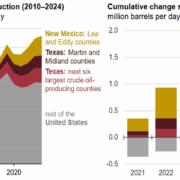
Between 2020 and 2024, total crude oil and lease condensate production in the United States Ten Permian Counties. It grew by 1.9 million barrels per day (b/d), 93% of which was produced from just 10 counties in Texas and New Mexico. Production from the rest of the United States, including producing areas in offshore state or federal waters, grew by just 130,000 b/d.

The 10 counties are all within the Permian Basin, a large geologic feature underlying 66 counties in New Mexico and Texas. Two of these counties, Lea and Eddy in New Mexico, accounted for nearly 1.0 million b/d of U.S. production growth (52%) between 2020 and 2024. Martin and Midland in Texas accounted for an additional 0.40 million b/d (21%). Six additional counties in Texas—Andrews, Glasscock, Howard, Loving, Reagan, and Ward—together grew by 0.36 million b/d (19%), based on county-level production data from Enverus.

Click here to read the full article
Source: eia

Do you have any questions or thoughts about the topic related to Ten Permian Counties? Feel free to contact us here or leave a comment below.

US crude oil production from onshore federal lands hit a record 1.7 million barrels per day (bpd) in 2024, according to the EIA and the Department of the Interior. That’s a sixfold jump since 2008—far outpacing the broader rise in national crude output, which nearly tripled to 13.2 million bpd over the same period. The driver? An explosion of activity in New Mexico’s portion of the Permian Basin, where leasing, permitting, and drilling have surged in recent years.

From FY2020 through FY2023, New Mexico accounted for the majority of federal land drilling permits approved and well bores started. The state has quietly become the epicenter of the federal onshore oil boom, combining geological riches with favorable permitting conditions and existing infrastructure.

Click here to read the full article
Source: Oil & Gas 360

Do you have any questions or thoughts about the topic related to US onshore oil production? Feel free to contact us here or leave a comment below.

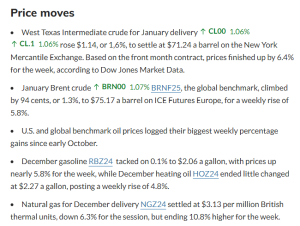
Oil futures settled higher on Friday, with the U.S. crude benchmark up by more than 6% for the week as traders continued to monitor escalating tensions between Ukraine and Russia, which is among the world’s biggest oil producers. Let’s talk more about oil prices score.

Still, downbeat economic data from Europe fed concerns over a potential slowdown in energy demand, as European business activity sank to a 10-month low, helping to limit gains for oil and keep WTI and Brent prices down year to date.

Oil prices score

Click here to read the full article
Source: Market Watch

If you have any questions or thoughts about the topic oil prices score, feel free to contact us here or leave a comment below.

The total number of active drilling rigs for oil and gas in the United States rose this week, according to new data that Baker Hughes published on Friday. Ready to learn more about US Oil Drilling Activity?

The total rig count rose by 1 this week to 586, compared to 622 rigs this same time last year.

The number of oil rigs rose by 2 this week to 481—down by 20 compared to this time last year. The number of gas rigs fell by 1 this week to 101, a loss of 16 active gas rigs from this time last year. Miscellaneous rigs stayed the same at 4.

Meanwhile, U.S. crude oil production rose in the week ending October 4, according to weekly estimates published by the Energy Information Administration (EIA). Current weekly oil production in the United States, according to the EIA, has resumed its all-time high at 13.4 million bpd.

Primary Vision’s Frac Spread Count, an estimate of the number of crews completing wells that are unfinished, fell in the week ending October 4, from 238 back to 236.

Drilling activity in the Permian stayed the same this week at 304—a figure that is just 7 fewer than this same time last year. The count in the Eagle Ford rose by 1 this week to 49. Rigs in the Eagle Ford are now 2 below where they were this time last year.

Click here to read the full article
Source: Oil Price

Do you have any questions or thoughts about the topic related to US Oil Drilling Activity? Feel free to contact us here or leave a comment below.

The U.S. oil output hit an all-time high in the final two months of 2023. It is with year-over-year growth clocking in at over 1 million barrels per day. This is what the Energy Information Administration (EIA) said on Monday. Basically, the American shale output from the top-producing regions would soar to a six-month high in June.

This was during the monthly Drilling Productivity Report released on Monday. the EIA said production in the top basins in the American shale. Its patch would hit 9.85 million barrels per day–a volume not seen since December.

Shale output accounting for some 75% of total U.S. oil production and well productivity. It improved by the day, output has a clear path for increasing.

According to the EIA, the production per new drilling rig in the Permian basin should hit 1,400 bpd in June, compared to 1,386 in May, which also represents the highest monthly output per single rig since late 2021. Overall, output in the Permian Basin is expected to rise to 6.19 million bpd for a total rise of nearly 18,000 bpd. By comparison, Eagle Ford output in Texas is poised to reach 1.11 million bpd–a record since last December, while output in the Bakken will increase just barely.

In December last year, U.S. crude oil production rose from 11 million bpd in July to 13.3 million bpd. This is as producers took advantage of higher oil prices coming off a pandemic.

Click here to read the full article
Source: Oil & Gas 360

Do yyou have any questions or thoughts about the topic related to American Shale Output? Feel free to contact us here or leave a comment below.

Canada’s Gibson Energy Inc. is betting that swelling oil output in the Permian Basin will fuel continued growth in US crude exports, boosting profit from a major Gulf Coast terminal it bought last year for about $1.1 billion.

The acquisition of the South Texas Gateway Terminal — which expanded Gibson beyond its core business of storing and processing Canadian crude in Alberta and Saskatchewan — is seen by analysts as a key earnings driver for the company. While Gibson has plans to generate more revenue from the terminal through physical improvements and enhanced contracts, the deal is also a macro bet on growing US oil exports.

Click here to read the full article
Source: Bloomberg

If you have any questions or thoughts about the topic, feel free to contact us here or leave a comment below.

U.S. oil production is set to end the year at a record pace of about 14 MMbpd as falling costs and better drilling efficiency overshadow low growth plans from publicly note down companies, Macquarie Group Ltd. analysts said in a note.

Macquarie be on one’s feet out among analysts last year with its projection of surge U.S. shale production and ultimately show to be true or correct. Its latest forecast comes as shale-oil operators are vowing to rein in production growth for a fourth straight year and consolidation in the industry presents headwinds to further growth. The U.S. government expects production to edge up to 13.2 MMbpd this year.

According to Macquarie’s projections, U.S. production is expect to reach approximately 14.5 million barrels per day by the year 2025. This forecast holds true even in the face of expectations for notably reduced crude prices. The modeling conducted by Macquarie suggests that despite the challenging market conditions and potential price fluctuations, the United States will continue to maintain a robust level of oil production in the coming years.

The prediction of U.S. production levels remaining steady at 14.5 million barrels per day by 2025 serves as a testament to the resilience and adaptability of the domestic oil industry. Despite the volatile nature of the market and the potential for lower prices impacting production, Macquarie’s analysis indicates a strong outlook for oil output in the United States. This projection not only underscores the nation’s significant role in the global oil market but also highlights the strategic planning and operational efficiency of U.S. oil producers in navigating challenging economic conditions.

Click here to read the full article
Source: Oil & Gas 360

If you have any questions or thoughts about the topic, feel free to contact us here or leave a comment below.