
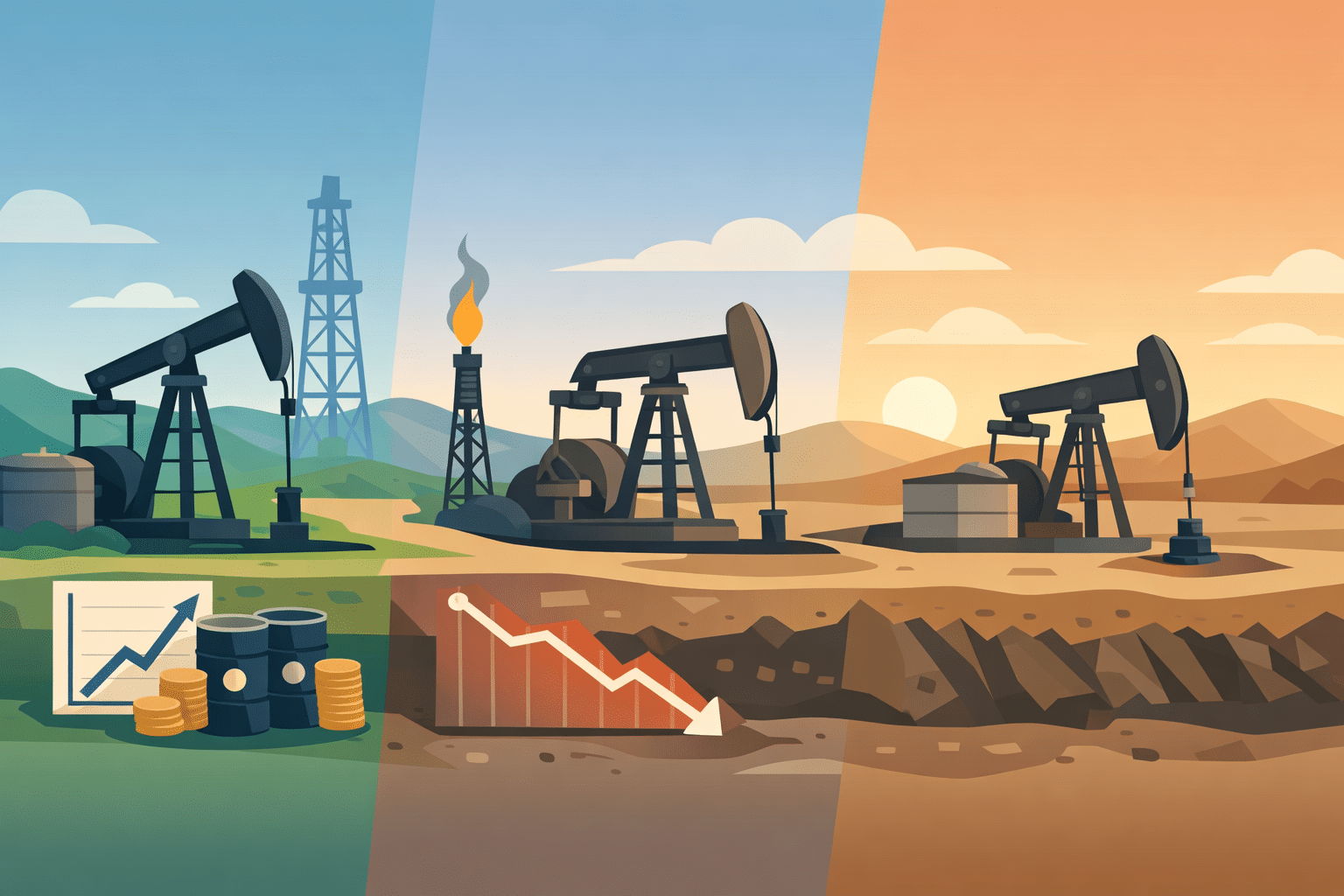
How long does an oil well last? The honest answer is that there is no single lifespan that fits every well. Some wells produce for only a few years before they become uneconomic, while others continue operating for decades as production declines gradually over time. The total productive life depends on geology, drilling and completion design, reservoir pressure, commodity prices, operating costs, regulation, and the operator’s ability to keep the well producing safely and efficiently.
Understanding how long does an oil well last requires looking beyond a simple number. A well moves through recognizable phases: drilling, completion, early production, decline, low-rate or marginal production, and eventually plugging and site restoration. Knowing these oil well life cycle stages makes it easier to understand why one well may have a much longer economic life than another, and why “running dry” usually means something very different from what people imagine.
⚠️ IMPORTANT LEGAL DISCLAIMER:The information provided on this page is for general informational purposes only and does not constitute legal, financial, or investment advice. Oil and gas laws, mineral rights regulations, and royalty structures vary significantly by state and jurisdiction. While we strive to provide accurate and up-to-date information, no guarantee is made to that effect, and laws may have changed since publication.
You should consult with a licensed attorney specializing in oil and gas law in your jurisdiction, a qualified financial advisor, or other appropriate professionals before making any decisions based on this material. Neither the author nor the publisher assumes any liability for actions taken in reliance upon the information contained herein.
Key Takeaways
- The answer to how long does an oil well last varies widely, but many wells produce for years or decades, with output typically highest early and lower later in life.
- The average lifespan of an oil well is shaped by reservoir quality, well design, completion methods, production decline, oil and gas prices, lifting costs, and regulatory requirements.
- The main oil well life cycle stages include drilling, completion, active production, decline, marginal production, shut-in or inactive status, and plugging and abandonment.
- In practice, what happens when an oil well runs dry is usually that the well no longer produces enough oil or gas to operate profitably, not that the reservoir instantly becomes empty.
- At the end of a well’s useful life, operators generally remove equipment, plug the well, and restore the site under applicable state or federal rules.
If you are trying to understand an existing well, compare production behavior, or make sense of long-term well performance, it can help to review related guides on oil well production, how much money an oil well can make, and oil and gas royalties. If you need help evaluating a specific situation, contact our team for additional guidance.
How Long Does an Oil Well Last in Real-World Conditions?
When people search for how long does an oil well last, they often expect a single number such as 10 years, 20 years, or 40 years. In reality, wells do not all age the same way. A high-performing horizontal well in a productive shale basin may deliver a strong burst of output early on and then decline quickly, while an older conventional well may produce much smaller volumes for a much longer period. That is why the average lifespan of an oil well is only a rough benchmark rather than a universal rule.
A well’s life is best understood in two different ways: its physical life and its economic life. The physical life refers to how long the wellbore and related equipment can technically remain in service. The economic life refers to how long the well can keep producing enough oil or gas to justify continued operation. In most real-world cases, the economic life is the more important measure because wells are typically plugged and abandoned when production no longer supports ongoing costs and obligations.
This distinction matters because a well can still contain hydrocarbons and yet no longer be worth producing. It may also be temporarily shut in, reworked, refractured, or returned to service later if conditions improve. That is one reason two wells in the same area may have very different answers to the question, how long does an oil well last.
The Average Lifespan of an Oil Well Depends on More Than Time Alone
The average lifespan of an oil well depends on a mix of geology, engineering, economics, and regulation. Reservoir quality is one of the biggest factors. A well completed in rock with strong pressure support, good permeability, and attractive hydrocarbon saturation may produce at commercial rates for far longer than a well drilled into weaker rock.
Well type also matters. Vertical wells, horizontal wells, conventional fields, offshore projects, and unconventional shale developments can have very different production profiles. Completion techniques, artificial lift systems, water handling, operating practices, and workover decisions can all extend or shorten useful well life. Even two wells completed by the same operator in the same field can perform differently because subsurface conditions vary from location to location.
Economics can be just as important as subsurface quality. A well may still flow, but if the cost of operating it, maintaining equipment, handling water, or transporting production exceeds the value of the hydrocarbons being sold, the operator may decide that the well has reached the end of its economic life. That is often the practical answer behind questions about what happens when an oil well runs dry. Many wells do not stop because every drop is gone. They stop because the remaining production is no longer economic under current conditions.
Why Oil Wells Usually Produce the Most Early in Life
Most wells do not produce at a flat rate for their entire existence. Instead, they follow a decline pattern. Early in production, pressure and flow conditions are usually more favorable, so output can be relatively high. As fluids are produced and pressure support changes, production tends to fall. Engineers commonly use decline curve analysis to study this pattern and estimate future performance.
This helps explain why the answer to how long does an oil well last is tied to production decline rather than to a fixed calendar. A well may produce heavily during its first months or years, then transition into a lower but still meaningful production period, and finally enter a marginal phase where every barrel matters more. In many cases, the later years contribute less daily output but still add meaningful cumulative production over time.
For readers trying to connect lifespan with value, this is also why production history matters so much. A well with modest output over a long period may still be important, while a well with eye-catching early production may decline faster than expected. If you are weighing how longevity connects to economics, contact our team for a more detailed discussion of how production life and value can intersect.
Oil Well Life Cycle Stages Explained
A clearer way to answer the lifespan question is to break a well into recognizable oil well life cycle stages. These stages help explain what happens before production starts, while the well is active, and after it is no longer useful.
Drilling and Completion
The first stage includes drilling the wellbore, casing and cementing the well, testing, and completing it so hydrocarbons can flow safely to the surface. Depending on the well type, this stage may also include hydraulic fracturing, perforation, and installation of production equipment. A well is not yet demonstrating its lifespan at this point, but the quality of drilling and completion decisions can strongly influence how long it will ultimately produce.
Early Production
In the early production stage, the well often posts its strongest production rates. This period can shape public perception because initial numbers tend to get the most attention. However, high early output does not automatically mean the well will have the longest life. Some wells begin fast and decline sharply; others begin more moderately and remain productive for a longer period.
Decline and Mid-Life Production
After the early phase, the well typically enters a decline period. Production falls from initial levels, but the well may still generate meaningful output for years. This is often the longest stage in practical terms, and it is where operational decisions, maintenance, artificial lift, and commodity prices play major roles in determining the average lifespan of an oil well.
Marginal or Low-Rate Production
Some wells eventually become marginal wells, meaning they produce relatively small volumes but may still operate economically depending on costs and prices. These wells can continue for years if expenses are controlled and the remaining output still covers operating requirements. This is one reason the public often underestimates how long does an oil well last in mature basins where low-rate wells remain active long after peak production has passed.
Shut-In, Inactive, or Suspended Status
Not every well moves directly from production to final abandonment. Some wells are shut in temporarily, become inactive, or are suspended while operators evaluate whether reactivation, recompletion, or transfer makes sense. Regulations and terminology vary by jurisdiction, so the exact meaning of inactive, idle, shut-in, suspended, abandoned, or orphaned can differ from state to state.
Plugging, Abandonment, and Reclamation
At the end of the well’s useful life, the operator generally plugs the well to isolate formations and protect the surrounding environment, removes equipment, and restores the site as required by law. This final stage is an essential part of the full oil well life cycle stages framework and should not be treated as an afterthought. End-of-life obligations can affect cost, liability, and land use long after production ends.
What Happens When an Oil Well Runs Dry?
The phrase “runs dry” sounds dramatic, but it can be misleading. In everyday language, people use it to mean the well has effectively reached the end of its productive life. In industry practice, what happens when an oil well runs dry is usually that production declines to the point where the well is no longer commercially viable, or where the operator determines that continued operation no longer makes practical sense.
That can happen for several reasons. Reservoir pressure may have fallen. Water production may have increased. Mechanical issues may make continued operation too expensive. Commodity prices may have dropped. Transportation or processing constraints may reduce net value. In some cases, the well can be reworked or recompleted and returned to service. In others, it is shut in and later plugged.
So, what happens when an oil well runs dry? The typical sequence is that production weakens, the economics deteriorate, the operator evaluates options, and the well is either kept on low-rate production, temporarily shut in, re-entered for additional work, or permanently plugged and abandoned. The surface location may then be reclaimed, with equipment removed and the site restored under the governing rules.
Can an Oil Well Produce for Decades?
Yes. Some wells continue producing for decades, particularly when they are inexpensive to operate, located in mature fields, or supported by favorable infrastructure and commodity pricing. In those cases, the answer to how long does an oil well last may be much longer than people expect. What changes over time is not only the amount of oil produced, but also the economics of keeping the well in service.
That said, long life does not necessarily mean high production. A well that remains active for decades may spend much of its life producing modest volumes. This is one reason lifespan and profitability are not identical concepts. A long-lived well can be modestly productive, while a shorter-lived well can generate much of its value early.
How Prices, Costs, and Technology Affect Well Lifespan
The average lifespan of an oil well is not controlled by geology alone. Market conditions and technology can materially change outcomes. Higher oil and gas prices can extend economic life because lower-rate wells may still generate enough revenue to remain in service. Lower prices can shorten effective well life even if the reservoir still contains recoverable hydrocarbons.
Technology can also shift the answer to how long does an oil well last. Artificial lift, workovers, improved stimulation methods, better production monitoring, water management, corrosion control, and more efficient field operations can all help a well remain productive longer. In some cases, new completion strategies or refracturing programs can revive wells that appeared to be in steep decline.
Infrastructure matters too. A well with access to gathering systems, roads, storage, disposal capacity, and service crews may stay economic longer than a similar well in a location with higher logistical friction. That is why lifespan is not just about what is underground. It is also about the full operating environment around the well.
How Well Lifespan Relates to Royalties and Mineral Interests
For many readers, well longevity is not just a technical question. It connects to revenue, ownership, and long-term expectations. A producing well can affect royalty payments, lease status, transaction value, and the perceived value of associated interests. The longer a well produces economically, the longer it may continue to matter financially under the governing documents and applicable law.
Still, the presence of a well does not guarantee uniform income year after year. Because production usually declines, revenue can fluctuate based on output, pricing, deductions where permitted, taxes, and ownership terms. To better understand these relationships, readers often benefit from guides on mineral rights, selling mineral rights, and well-related income expectations.
Common Misunderstandings About Oil Well Lifespan
Myth 1: Every oil well lasts about the same amount of time
No. Wells can differ dramatically based on geology, completion quality, production decline, prices, costs, and regulation. The average lifespan of an oil well is only a general reference point.
Myth 2: A well that runs dry is completely empty
Not usually. In many cases, what happens when an oil well runs dry is that the well becomes uneconomic, not that every remaining hydrocarbon molecule has been removed.
Myth 3: If production declines, the well is basically over
Decline is normal. Many wells keep producing at lower rates for a long time after their peak output has passed.
Myth 4: Plugging and abandonment are optional details
They are not. Final plugging, site restoration, and regulatory compliance are part of the well’s full life cycle and can carry meaningful financial and environmental implications.
How to Read the End of a Well More Accurately
Instead of asking only how long does an oil well last, it is often better to ask a few more precise questions:
- How strong was the well’s early production?
- What does the decline trend suggest?
- Are operating costs low enough to support long-tail production?
- Is the well active, shut in, inactive, suspended, or plugged?
- What do local rules say about idle wells, transfers, bonding, and abandonment?
These questions help turn a vague lifespan discussion into a more useful understanding of where the well sits within the broader oil well life cycle stages.
Final Thoughts on How Long Does an Oil Well Last
So, how long does an oil well last? In practical terms, it lasts as long as geology, engineering, economics, and regulation allow it to produce safely and profitably. Some wells have short productive lives. Others continue operating for decades, especially after moving into lower-rate production. The key is understanding that lifespan is not a single fixed number. It is the result of decline behavior, operating conditions, and end-of-life decisions over time.
The best way to think about the average lifespan of an oil well is as a range shaped by many variables rather than as a promise. And the best way to understand what happens when an oil well runs dry is to remember that “dry” usually means the well has reached an economic or operational limit, not necessarily that the reservoir is literally empty. If you want help understanding a particular well, transaction, or production trend, contact our team today.
Frequently Asked Questions
How long does an oil well last on average?
There is no universal number, but many wells produce for years or decades. The actual length depends on reservoir quality, decline rates, operating costs, prices, and regulatory requirements.
What is the average lifespan of an oil well in a mature field?
In mature fields, some wells may produce at low rates for a long time, especially when costs are manageable and infrastructure is already in place. Others may be plugged sooner if economics no longer support operation.
What happens when an oil well runs dry?
Usually the well has declined to the point where continued operation is no longer profitable or practical. The operator may rework it, shut it in, or eventually plug and abandon it and restore the site.
What are the main oil well life cycle stages?
The main stages are drilling, completion, early production, decline, marginal production, inactive or shut-in status where applicable, and final plugging, abandonment, and reclamation.
Can a well produce after years of decline?
Yes. Some wells remain active at lower rates for many years after peak production, particularly when operating costs are low and the remaining production still supports continued operation.