
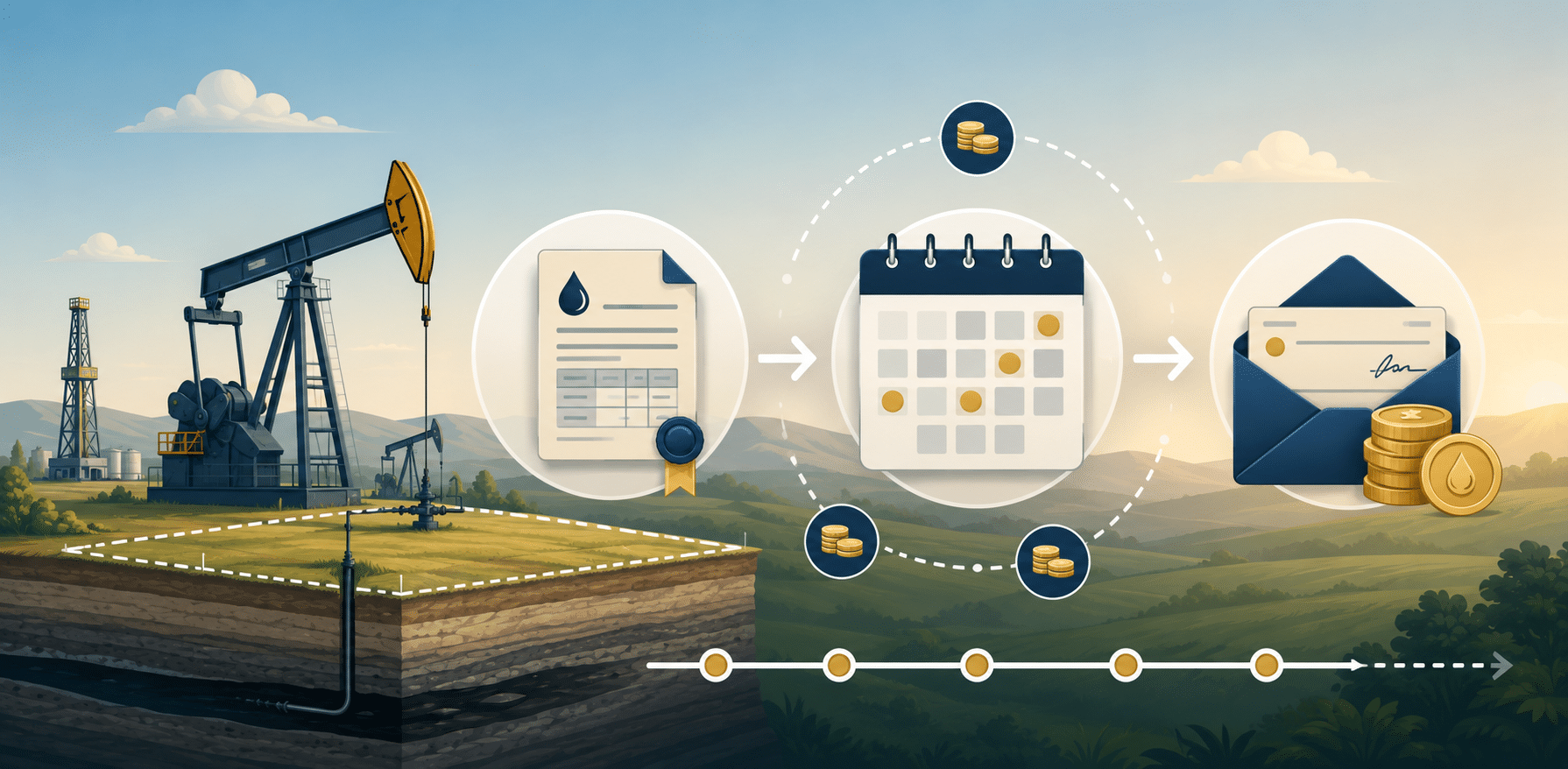
When are oil and gas royalty payments made? In many producing properties, royalty proceeds are distributed monthly, but the first check usually arrives several months after the first sale of oil or gas. The exact timing depends on the lease, state law, the operator or purchaser’s accounting cycle, title verification, division-order processing, and any minimum-payment threshold.
A royalty payment is not normally triggered by signing a lease, drilling a well, or announcing production. Payment generally follows the sale of production and the confirmation of who is legally entitled to receive the proceeds. This guide explains the typical oil and gas royalty payment schedule, the first oil and gas royalty payment timeline, common reasons checks are delayed, and the records that can help an owner investigate a missing or unexpected payment.
⚠️ IMPORTANT LEGAL DISCLAIMER: The information provided on this page is for general informational purposes only and does not constitute legal, financial, or investment advice. Oil and gas laws, mineral rights regulations, and royalty structures vary significantly by state and jurisdiction. While we strive to provide accurate and up-to-date information, no guarantee is made to that effect, and laws may have changed since publication.
You should consult with a licensed attorney specializing in oil and gas law in your jurisdiction, a qualified financial advisor, or other appropriate professionals before making any decisions based on this material. Neither the author nor the publisher assumes any liability for actions taken in reliance upon the information contained herein.
Key Takeaways
- Royalty payments generally begin after production is sold, not immediately after a lease is signed or a well is drilled.
- The first payment often takes longer than later payments because title, ownership, tax forms, and division-order details must be confirmed.
- Monthly payments are common, but quarterly or annual checks may occur when proceeds do not reach a contractual or statutory minimum threshold.
- Oil and gas may be paid on different accounting schedules because they are measured, transported, processed, and sold differently.
- A missing check does not always mean production stopped. Funds may be held in suspense because of a title issue, address problem, unsigned document, tax-form issue, ownership transfer, or small balance.
- State laws can establish first-payment deadlines, later-payment deadlines, interest obligations, notice procedures, and exceptions. Always verify the law governing the well.
- Royalty statements, division orders, leases, deeds, production records, and correspondence should be retained and compared regularly.
When Are Oil and Gas Royalty Payments Made? Steps Before a Check
Understanding the payment process is easier when the major events are separated. An oil and gas lease may create the right to receive a royalty if production occurs, but it does not guarantee that a well will be drilled or that hydrocarbons will be sold. A typical payment sequence includes the following steps:
- Ownership and lease rights are established. The operator reviews mineral rights ownership, deeds, assignments, probate documents, leases, pooling instruments, and other title records to determine who owns the mineral or royalty interest.
- A well is drilled and completed. A completed well may still require testing, connection to gathering systems, regulatory approvals, or additional work before commercial sales begin.
- Production is measured and sold. Oil may be stored and sold in batches, while natural gas is commonly metered into a gathering or pipeline system. The relevant date for payment laws is often the date or month of first sale rather than the first day the well physically produces.
- Sales information is reconciled. The operator, purchaser, processor, or payor receives volume, quality, price, tax, and deduction information. Adjustments may be made after initial estimates.
- Ownership decimals are confirmed. A division order commonly identifies the owner, well or unit, payor, and decimal interest used to allocate revenue.
- Payment is released. Once the payor determines that title is marketable and the owner has completed required administrative steps, proceeds are paid by check, direct deposit, or another approved method.
This sequence explains why the answer to “when are oil and gas royalty payments made” cannot be measured from the lease-signing date alone. A lease may be signed years before drilling, and drilling may occur months before first sale. The practical clock usually begins when production is marketed, subject to the governing contract and state law.
Typical Oil and Gas Royalty Payment Schedule
The most common oil and gas royalty payment schedule is monthly after the account is established, but “monthly” does not mean payment for the current month’s production. Royalty accounting is generally paid in arrears. A check issued in September might relate to oil sold in July or gas sold in June, depending on the payor’s system and the applicable legal deadline.
Several timing patterns are common:
- Monthly: The owner receives a payment each month when the balance exceeds the minimum threshold and no suspense issue exists.
- Quarterly: Some payors issue checks every three months, or a small interest may reach the payment threshold only once per quarter.
- Annually: Very small balances may be accumulated and paid once a year where the lease or state law permits.
- Irregularly: Payments may vary when oil is sold in batches, a well is temporarily shut in, production is corrected, ownership changes, or prior-period adjustments are posted.
Owners frequently ask how often are oil and gas royalty checks paid because the cadence can change without an obvious event at the well. The safest approach is to identify the production month shown on the statement, the payment date, the payor’s minimum threshold, and whether the statement includes adjustments from earlier periods.
For a broader explanation of royalties, ownership types, deductions, and valuation concepts, review the complete guide to oil and gas royalties.
If you are organizing leases, division orders, and payment statements and need help identifying which documents relate to a producing interest, you may contact the Ranger Land and Minerals team for a general discussion about the records you have.
First Oil and Gas Royalty Payment Timeline
When are oil and gas royalty payments made for a new well? The first oil and gas royalty payment timeline is usually longer than the schedule for later checks. Before the first payment is released, the payor may need to complete title review, establish an owner account, calculate the decimal interest, obtain a taxpayer identification form, process a division order, verify an address, and reconcile the first sales data.
A simplified first-payment timeline may look like this:
| Stage | What Happens | Why Timing Can Vary |
|---|---|---|
| Lease and title review | Ownership, royalty rate, unit participation, and burdens are examined. | Probate, trusts, old deeds, assignments, or conflicting records can require additional curative work. |
| Drilling and completion | The well is drilled, completed, tested, and prepared for sales. | Infrastructure, weather, mechanical work, permits, or market conditions may delay first sale. |
| First sale | Oil or gas is marketed and sales proceeds begin to accrue. | The first sale date may be later than the first production date. |
| Division-order and account setup | The payor confirms the owner’s decimal, tax status, payment method, and contact information. | Missing forms, returned mail, title questions, or disputed decimals can place funds in suspense. |
| First payment | Accumulated proceeds for eligible production months are released, often with a detailed statement. | State law, lease language, payor policy, and title status control the deadline and any exceptions. |
Because the first check may include more than one production month, it can be larger than the checks that follow. That does not necessarily mean production suddenly declined after the first payment. The first statement should be reviewed by production month, product, volume, price, decimal interest, deductions, taxes, and adjustments.
Example: A Texas First-Payment Timeline
Texas provides a useful example, but it should not be treated as a nationwide rule. Under Texas Natural Resources Code Chapter 91, proceeds from the first sale generally must be paid on or before 120 days after the end of the month of first sale, subject to the statute’s requirements and exceptions.
Assume a well’s first sale occurs on April 15. The 120-day period is measured after April 30, not from the date the lease was signed and not necessarily from the day drilling began. If title is marketable and the owner is otherwise entitled to payment, the statutory first-payment deadline would generally fall in late August. Later payments generally follow separate deadlines for oil and gas under the same statute unless a qualifying agreement provides otherwise.
This distinction corrects a common misunderstanding about the first oil and gas royalty payment timeline: the relevant event is usually first sale, not simply “striking oil.” A well can produce during testing or flowback before marketable volumes are reported as sold.
Examples From Other Producing States
State rules differ materially. Oklahoma’s Production Revenue Standards Act generally requires payment to begin no later than six months after first sale, followed by later payment deadlines described in the statute. North Dakota provides a different framework; the North Dakota Department of Mineral Resources explains that its law addresses royalties unpaid within 150 days after production is marketed and may impose interest in qualifying circumstances.
These examples show why a single universal number is misleading. The applicable rule may depend on the state where the well is located, the kind of interest owned, whether title is marketable, who holds the proceeds, and whether the governing documents alter a default deadline where legally permitted.
How Often Are Oil and Gas Royalty Checks Paid?
For many producing interests, the practical answer to how often are oil and gas royalty checks paid is once per month. However, the statement received in a given month usually reflects production and sales from an earlier month. The lag allows the operator and purchaser to finalize volumes, quality adjustments, contract prices, taxes, processing charges, transportation charges, and ownership allocations.
Oil and gas can follow different lags. In Texas, for example, later oil proceeds are generally due within 60 days after the end of the month in which the oil is sold, while later gas proceeds are generally due within 90 days, subject to statutory and contractual details. In other states, the timing may differ. Even within the same well, one product may appear on a statement before another.
Why Gas Payments May Lag Oil Payments
Natural gas accounting can involve multiple downstream steps. Gas may be gathered, compressed, treated, processed, transported, and separated into residue gas and natural gas liquids. Final settlement information may not be available immediately. Contractual price formulas can also depend on index prices, heating value, plant statements, or later adjustments.
Oil is often measured at tanks or lease facilities and sold in batches to a purchaser. Its accounting may be more direct, although quality differentials, transportation, taxes, and purchaser corrections can still affect timing. These operational differences help explain why an oil and gas royalty payment schedule may show separate product lines and different production months on the same check detail.
Minimum-Payment Thresholds
A payor may hold small balances until they reach a minimum amount. The threshold may be stated in the lease, division order, owner-relations policy, or applicable law. For example, Texas law permits certain small aggregate balances of $100 or less to be accumulated and remitted annually. Other states and agreements use different thresholds or allow an owner to request more frequent payment.
When a check stops but the well still reports production, ask whether the account is below the minimum payment threshold. The money may remain credited to the owner rather than disappearing. A later check may combine several months once the balance reaches the release amount.
How Royalty Payments Are Calculated
Payment timing and payment amount are separate questions. A check can arrive on schedule and still require review. A simplified royalty calculation is:
Royalty proceeds = production sold × sales price × lease royalty rate × ownership share, less authorized taxes, deductions, and adjustments.
The decimal shown on a division order often combines the owner’s net mineral acres, the size of the pooled or producing unit, and the royalty fraction. Additional burdens or conveyance terms may affect the final decimal. For a more detailed explanation of ownership decimals, see the Ranger Minerals guide to division orders for mineral rights.
A royalty statement may include:
- Operator, purchaser, or payor name
- Well, lease, property, or unit identifier
- Production month and payment date
- Oil, gas, condensate, or natural gas liquids
- Gross volume and owner volume
- Sales price or value
- Owner decimal interest
- Severance and production taxes
- Gathering, compression, processing, transportation, or marketing deductions where authorized
- Prior-period adjustments
- Net payment amount
Owners should compare the statement to the lease and division order rather than reviewing only the check total. The guide to oil and gas revenue checks provides additional context for reading statement fields.
Why a Royalty Payment May Be Delayed or Placed in Suspense
A delayed payment can result from routine accounting, a legal title issue, or an administrative problem. “Suspense” generally means proceeds are being held rather than distributed because the payor believes a condition must be resolved. The reason should be identified before deciding how to respond.
Common Reasons for Suspense or Nonpayment
- Unmarketable or disputed title: Conflicting deeds, missing conveyances, unreleased liens, probate gaps, or unclear ownership can prevent payment.
- Inheritance documentation: The payor may need probate orders, affidavits, trust documents, death certificates, or recorded assignments before changing the owner record.
- Unsigned or disputed division order: A payor may request a signed division order or clarification of the decimal interest before releasing funds, depending on state law and the governing documents.
- Missing tax form: An incomplete Form W-9 or taxpayer identification mismatch can delay payment or trigger backup withholding.
- Address or returned-mail problem: Checks and division orders may be returned because the owner-relations file is outdated.
- Minimum threshold: The accrued amount may be below the payor’s release level.
- Ownership transfer: A sale, gift, trust transfer, estate distribution, divorce, or entity change can require title review.
- Well or infrastructure downtime: Mechanical repairs, weather, pipeline constraints, plant maintenance, or shut-in periods can reduce or stop sales.
- Accounting adjustment: Purchasers may revise volumes, prices, taxes, or deductions after receiving corrected data.
- Unclaimed property: Long-unresolved or undeliverable funds may eventually be reported to a state unclaimed-property program under applicable law.
If the expected payment date has passed, do not rely on a general estimate alone. Compare the well’s state, first-sale month, production month, lease language, payor, division-order status, threshold, and suspense reason. If the account has been held because documents are missing or ownership is unclear, contact Ranger Land and Minerals to discuss the interest and the records that may need to be organized before you speak with the operator, purchaser, attorney, or title professional.
What to Do When a Royalty Check Is Late
A structured inquiry is more effective than asking only whether a check has been mailed. Use the following process to create a clear record and narrow the cause of the delay.
- Confirm the payor. The operator is not always the party issuing royalty checks. Oil and gas purchasers, midstream companies, or designated disbursement agents may pay proceeds.
- Identify the well and owner number. Use the exact property, lease, unit, well, owner, and account identifiers shown on prior statements or correspondence.
- Determine the production and sales months. Ask which month first sale occurred and which production months have been processed.
- Ask for the suspense code and explanation. Request the specific reason, not merely confirmation that the account is “in suspense.”
- Request a document list. Ask what exact curative documents, tax forms, signatures, or address confirmations are needed.
- Verify the decimal interest. Compare the payor’s decimal with the lease, deed, pooling instrument, and division order.
- Review the applicable deadline. Check the state statute and the lease with qualified counsel when necessary.
- Send written notice when appropriate. Some states require written notice before certain remedies are available. Texas, for example, provides a statutory notice process for nonpayment claims.
- Keep a communication log. Record dates, names, ticket numbers, requested documents, delivery confirmations, and promised follow-up dates.
- Escalate professionally. If the issue remains unresolved, consult an oil and gas attorney, accountant, land professional, or other qualified advisor based on the nature of the problem.
For Texas interests, Chapter 91 of the Texas Natural Resources Code also addresses written notice, payment information, deductions, and related owner rights. A legal professional can explain whether those provisions apply to a particular dispute.
How to Read a Royalty Statement by Production Month
A royalty check date by itself does not show whether payment is timely. The statement should identify the production month associated with each line. Compare that month to the sale and payment rules for the relevant product and state.
For example, a statement issued in October could include July gas, August oil, and a correction for May condensate. The check is one payment, but it contains several accounting periods. This is why owners should track revenue by production month rather than by deposit date alone.
A simple tracking spreadsheet can include:
- Well or property name
- API or state well identifier
- Operator and payor
- Production month
- Product
- Gross volume
- Owner decimal
- Gross owner value
- Taxes and deductions
- Net payment
- Check or deposit date
- Notes about adjustments or suspense
Over time, this record can reveal missing months, unexplained decimal changes, large deduction shifts, repeated negative adjustments, or an unexpected difference between production trends and royalty income. The royalty audit guide discusses additional red flags and document-review practices.
What Causes Royalty Checks to Rise or Fall?
Even when payments arrive on a regular schedule, amounts can change substantially. The main drivers include production volume, commodity price, ownership decimal, lease royalty rate, product mix, taxes, deductions, and adjustments.
Production Decline and New Wells
Many oil and gas wells produce at their highest rate early in their life and decline over time. A falling check may reflect normal production decline rather than a payment error. Conversely, a new well, recompletion, workover, or additional unit development can increase revenue.
Commodity Prices
Royalty revenue is generally tied to the value of oil and gas sold. Prices may differ from widely quoted benchmarks because of location, quality, transportation, contract terms, basis differentials, and timing. The guide to factors affecting oil prices explains why market changes can affect royalty income.
Deductions and Taxes
Severance taxes and other production taxes can reduce the net check. Depending on the lease and jurisdiction, certain post-production expenses may also be deducted. These can include gathering, compression, dehydration, treatment, processing, transportation, or marketing. Whether a deduction is permitted is a legal and contractual question, not merely an accounting preference.
Adjustments
Payors may issue positive or negative adjustments when they receive corrected volumes, prices, tax rates, plant allocations, or ownership information. The adjustment should identify the affected production month. Large or recurring corrections should be documented and questioned when the explanation is unclear.
Division Orders and Their Role in Payment Timing
A division order is a payment-direction document that states how proceeds should be divided among owners. It commonly includes the property description, owner name, address, tax identification information, interest type, and decimal interest.
Before signing, compare the decimal with the lease royalty, net mineral acres, pooled-unit size, tract participation, and any prior conveyances. A division order should not be treated as a substitute for the lease or deed. State law may limit the extent to which a division order can change underlying rights.
Returning a correct division order promptly can reduce administrative delay. If the decimal appears wrong, request the calculation and supporting title information before signing. The Ranger Minerals division order glossary provides a plain-language introduction to the document.
Special Situations That Affect Payment Timing
Inherited Mineral or Royalty Interests
Inherited interests often remain in the deceased owner’s name until the operator or payor receives acceptable evidence of succession. Requirements vary by state and by the value and structure of the estate. Probate orders, affidavits of heirship, wills, trust documents, death certificates, and recorded deeds may be relevant.
Sold or Transferred Interests
Payments do not always switch immediately after a deed is signed. The purchaser or operator may require a recorded instrument, transfer order, W-9, and title review. The seller and buyer should clarify the effective date, allocation of proceeds, responsibility for adjustments, and treatment of payments received during the transition.
Multiple Payors
One property may generate separate checks from different purchasers or product streams. Oil, gas, and natural gas liquids can be paid by different entities. A change in purchaser can also create a temporary gap while owner records are transferred.
Shut-In or Temporarily Abandoned Wells
A well that is not selling production generally does not generate ordinary production royalties. A lease may provide for shut-in payments in limited circumstances, but shut-in payments are distinct from royalties on actual sales and depend on the lease language.
Royalty Interests Versus Working Interests
A royalty interest typically receives a share of production revenue without bearing drilling and operating costs, although taxes and authorized post-production deductions may apply. A working interest participates in revenue but also bears operating expenses and may receive joint-interest billing. Payment timing, statements, and tax treatment can therefore differ.
Tax Records Connected to Royalty Payments
Royalty statements should be retained with annual tax documents. The IRS Schedule E instructions state that gross royalty income is reported even when state or local taxes were withheld from oil or gas payments. Depending on the taxpayer and the interest, depletion and other tax rules may apply.
Owners should keep:
- Monthly or quarterly royalty statements
- Forms 1099 and withholding records
- Leases, deeds, assignments, and division orders
- Purchase or inheritance basis information
- Property and severance tax records
- Professional fees related to the interest
- Records of depletion calculations
Tax treatment depends on the owner’s facts, the type of interest, the transaction, and current law. The Ranger Minerals overview of mineral rights taxes can help identify topics to discuss with a qualified tax advisor.
Frequently Asked Questions
When are oil and gas royalty payments made after first production?
Payment usually follows the first sale of production rather than the first day a well produces. The first check commonly arrives several months later because the payor must reconcile sales data, verify title, establish the owner account, and apply the deadline required by the lease and state law.
How often are oil and gas royalty checks paid?
Monthly payment is common once an account is active, but checks may be quarterly, annual, or irregular when proceeds are below a minimum threshold, production is intermittent, a well is shut in, or funds are held in suspense.
Why is the first royalty check larger than later checks?
The first check may include several accumulated production months. Later checks may cover one month at a time. Production decline, commodity-price changes, taxes, deductions, and adjustments can also make later payments smaller.
Does signing an oil and gas lease start the royalty payment clock?
No. A lease may be signed long before a well is drilled. Royalty proceeds generally depend on production being sold, and statutory first-payment periods are often tied to the month or date of first sale.
Why did my royalty checks stop even though the well is producing?
The account may be below a minimum-payment threshold, in suspense because of title or tax-form issues, affected by a purchaser change, or waiting for corrected sales data. Contact the payor’s owner-relations department and request the specific status and suspense reason.
Are oil and gas paid on the same schedule?
Not always. Oil and gas can have different statutory deadlines and accounting lags. Gas often requires additional processing and settlement data, so it may be paid later than oil from the same property.
What documents should I review if a royalty payment is late?
Review the lease, deed, division order, pooling or unit documents, prior statements, W-9, owner-relations correspondence, probate or trust documents, and any notice identifying a title or suspense requirement.
Can interest be owed on late royalty payments?
Possibly. Some states impose interest when proceeds are not paid within statutory deadlines, subject to exceptions such as title disputes or inability to locate an owner. An oil and gas attorney can determine whether a particular interest or remedy applies.
Conclusion: Understanding Your Royalty Payment Timeline
When are oil and gas royalty payments made? The most reliable answer begins with the first sale of production, the law of the state where the well is located, and the documents governing the interest. Monthly checks are common after the account is established, but the first payment usually takes longer and may include several production months.
A useful review separates four questions: Has production been sold? Is title marketable? Has the owner account been completed? Has the applicable payment deadline passed? From there, the lease, division order, royalty statement, state statute, and owner-relations records can help explain the oil and gas royalty payment schedule.
Anyone evaluating a first oil and gas royalty payment timeline or asking how often are oil and gas royalty checks paid should avoid relying on a single nationwide estimate. State law, minimum thresholds, suspense issues, product accounting, purchaser practices, and ownership changes all influence the result.
For help discussing producing mineral or royalty interests, organizing payment records, or exploring available acquisition and investment opportunities, contact Ranger Land and Minerals today.