
Tag Archive for: gasproduction

The Permian Basin is becoming a larger part of U.S. natural gas supply, according to information highlighted by the Midland Reporter-Telegram from the U.S. Energy Information Administration’s June Short-Term Energy Outlook. Marketed natural gas production in the region increased from 17.2 billion cubic feet per day in 2021 to 27.6 Bcf/d in 2025, a 60% gain. Crude oil production also rose over the same period, moving from 4.7 million barrels per day to 6.6 million barrels per day, a 39% increase.

The EIA connected the faster gas growth to rising gas-oil ratios as reservoirs mature. In 2025, the Permian averaged nearly 4,200 cubic feet of natural gas for each barrel of oil produced, up 16% from 2021. If that ratio had stayed at the 2021 level, the agency estimated 2025 regional gas production would have been 23.8 Bcf/d, about 14% below actual output.

For mineral and royalty owners, the data provides useful context for tracking natural gas production and evaluating output trends across a major oil and gas basin. The changing production mix may also matter for infrastructure planning, market supply expectations, and how operators report future Permian development results.

Source: Midland Reporter-Telegram

Read the full original article here
Ranger Land & Minerals curates weekly insights from across the oil and gas industry to keep our readers informed. To receive news like this directly in your inbox, join our free newsletter. If you’d like to learn more about mineral rights and oil royalty opportunities, contact us to speak with a representative.
DISCLAIMER: The summary above is based on information from third-party sources believed to be reliable, but its accuracy and completeness cannot be guaranteed. It is provided for general informational purposes only and does not constitute investment, financial, tax, legal, or other professional advice, nor a recommendation or solicitation to buy or sell any security, commodity, or investment product. Markets, regulations, and circumstances can change, and the information may not reflect the most current developments. You should conduct your own research and consult a qualified financial advisor, CPA, or other professional before making decisions based on this content. The publisher and its affiliates disclaim any liability for losses or damages arising from reliance on the information provided above.

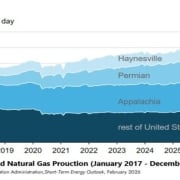
The U.S. Energy Information Administration (EIA) projects U.S. marketed natural gas production will rise about 2% to average 120.8 Bcf/d in 2026 and then increase to a record 122.3 Bcf/d in 2027. The agency expects roughly 69% of the next two years’ output to come from three core regions: Appalachia, Haynesville, and the Permian.

EIA attributes much of the growth to higher forecast prices supporting activity in Haynesville, where production is expected to increase by about 1.2 Bcf/d in 2026 and 1.6 Bcf/d in 2027. The outlook also notes the region’s proximity to Gulf Coast LNG export terminals and major industrial demand. In the Permian, EIA expects gas volumes to grow mainly as associated gas from oil production, aided by rising gas-to-oil ratios, with the basin contributing 1.4 Bcf/d of growth in 2026 and 0.6 Bcf/d in 2027. Appalachia is projected to post modest gains as additional takeaway capacity supports incremental increases after recent constraints—context that mineral owners often evaluate alongside average natural gas well production benchmarks and basin-specific dynamics like Permian associated gas trends.

Source: Gas Compression Magazine
Read the full original article here

Ranger Land & Minerals curates weekly insights from across the oil and gas industry to keep our readers informed. To receive news like this directly in your inbox, join our free newsletter. If you’d like to learn more about mineral rights and oil royalty opportunities, contact us to speak with a representative.
DISCLAIMER: The summary above is based on information from third-party sources believed to be reliable, but its accuracy and completeness cannot be guaranteed. It is provided for general informational purposes only and does not constitute investment, financial, tax, legal, or other professional advice, nor a recommendation or solicitation to buy or sell any security, commodity, or investment product. Markets, regulations, and circumstances can change, and the information may not reflect the most current developments. You should conduct your own research and consult a qualified financial advisor, CPA, or other professional before making decisions based on this content. The publisher and its affiliates disclaim any liability for losses or damages arising from reliance on the information provided above.