
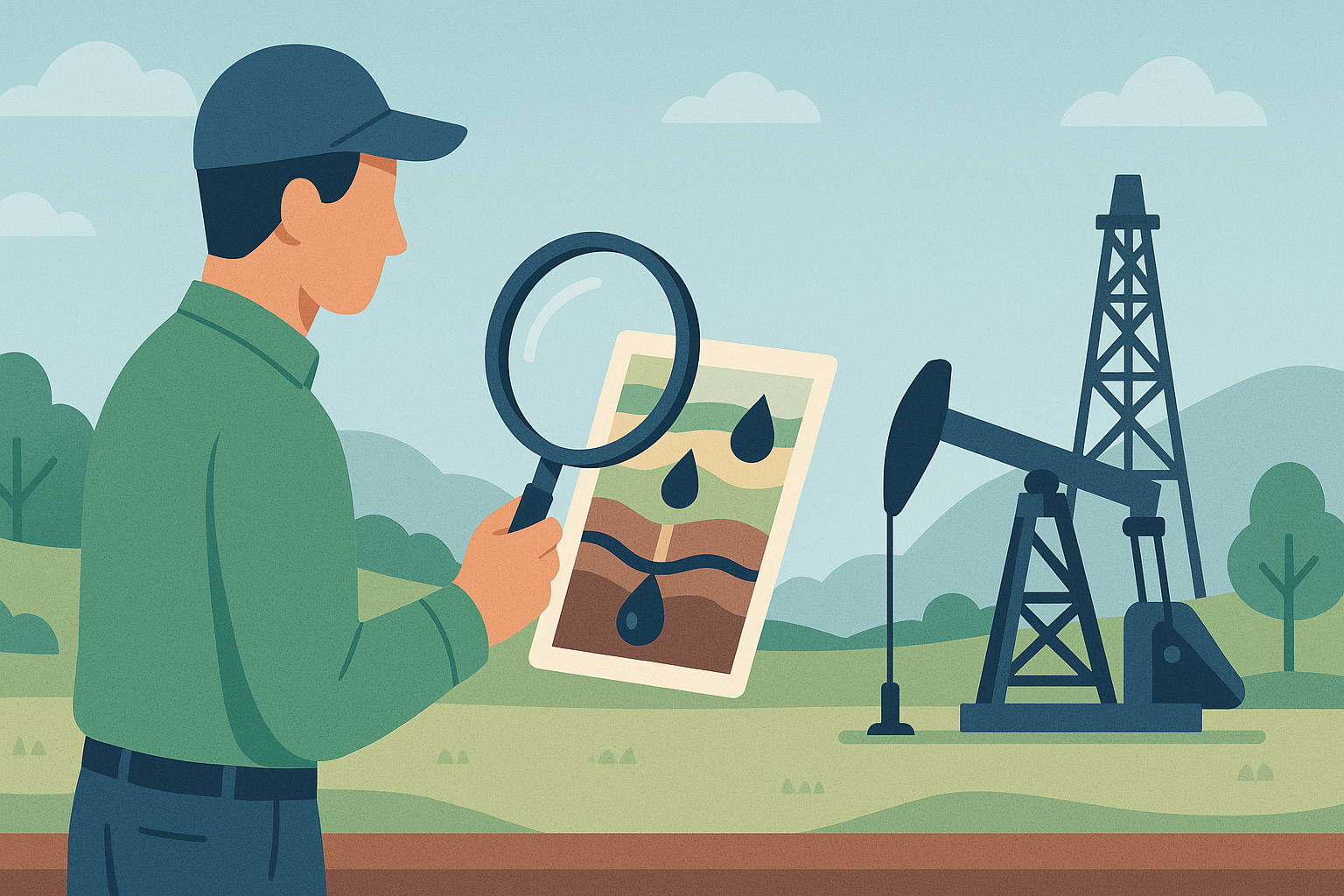
If you own property in or near an oil-producing region, it is natural to wonder whether there might be valuable oil or natural gas beneath your land. Stories of “striking oil” and long-term royalty income are common, but the real process behind how to find oil on your land is far more technical, regulated, and methodical than most people realize.
This guide explains the key stages of oil and gas exploration on private land. You will learn how ownership of the subsurface works, what mineral rights vs surface rights actually mean, how professionals evaluate drilling potential, what a seismic survey for oil exploration involves, and what options landowners typically consider if exploration activity moves forward.
⚠️ IMPORTANT LEGAL DISCLAIMER:
The information provided on this page is for general informational purposes only and does not constitute legal, financial, or investment advice. Oil and gas laws, mineral rights regulations, and royalty structures vary significantly by state and jurisdiction. While we strive to provide accurate and up-to-date information, no guarantee is made to that effect, and laws may have changed since publication.
You should consult with a licensed attorney specializing in oil and gas law in your jurisdiction, a qualified financial advisor, or other appropriate professionals before making any decisions based on this material. Neither the author nor the publisher assumes any liability for actions taken in reliance upon the information contained herein.
Key Takeaways
- Finding oil on your land starts with understanding who owns the subsurface and how mineral rights vs surface rights are defined in your state.
- Most modern oil and gas exploration on private land is carried out by professional operators, geologists, geophysicists, and landmen, not individual landowners drilling their own wells.
- A seismic survey for oil exploration, combined with regional geology and nearby well data, helps companies decide whether your property is a good candidate for drilling.
- Landowners may benefit through royalties, lease bonuses, mineral sales, or other structures, but actual income depends on well performance, prices, lease terms, and ownership decimals.
- Exploration and production can affect surface use, property value, and long-term obligations, so clear agreements and professional advice are essential.
- An experienced mineral rights and acquisitions team can help you evaluate offers, understand trade-offs, and align your decisions with your financial goals.
Why Ownership Matters Before You Explore
The first step in any realistic plan for how to find oil on your land is clarifying what you actually own. In many parts of the United States, it is possible for one party to own the surface of a property and another party to own the minerals beneath it. This separation is at the core of mineral rights vs surface rights.
Surface rights typically give you the ability to live on, build on, farm, or otherwise use the land at ground level. Mineral rights (sometimes called subsurface rights or the mineral estate) entitle their owner to explore for and produce oil, natural gas, and other minerals beneath the surface. In a traditional fee simple estate, the same owner controls both surface and minerals. Over time, however, mineral rights can be severed and sold separately, leaving different owners for each.
Your deed, title policy, or closing documents may indicate whether you acquired mineral rights along with the surface. However, in areas with a long history of oil and gas activity, minerals may have been carved up and transferred over decades. In those cases, a title review or a more in-depth examination of county records is often necessary to understand the current state of mineral rights vs surface rights for your property.
To learn more about how the subsurface can be owned and transferred separately from the surface, you can review the overview of subsurface rights and how they interact with above-ground land use.
If you are unsure how your deed describes your ownership or how a split estate might affect you, you can contact the Ranger Land and Minerals team to discuss your documents and what they may mean for potential oil and gas exploration on your land.
Placing Your Land in the Larger Geological Picture
Once you know who controls the minerals, the next step in understanding how to find oil on your land is to look beyond your property lines. Oil and gas exploration on private land rarely starts with a single parcel; it is part of a regional picture that includes basins, formations, prior wells, and existing infrastructure.
Important questions to ask include:
- Are there producing or previously producing oil or gas wells near your property?
- Is your land located within a known basin, play, or trend where operators are actively leasing and drilling?
- Do state oil and gas commission records show historical drilling, plugged wells, or pending permits in your area?
Nearby wells can provide useful context. If there is production close to your land, you may be able to see how long those wells have been active and whether there has been ongoing development over time. Resources such as Oil Well Production: Everything You Need to Know and Average Natural Gas Well Production can help you interpret basic production information you might find in public databases.
Even if there are no wells directly on your land, being in a proven or emerging play can matter. As infrastructure improves and operators refine their understanding of an area, development may gradually expand to new tracts of private land.
The Professionals Behind Private-Land Exploration
Contrary to popular images of wildcatters with a single well, modern oil and gas exploration on private land is a team effort that depends on specialized expertise. Landowners are important decision-makers, but they are rarely the ones designing exploration programs or operating heavy equipment.
Key professionals typically include:
- Geologists, who analyze rock types, structures, and depositional patterns to identify potential reservoirs and traps.
- Geophysicists, who design and interpret geophysical surveys, especially seismic data, to create three-dimensional images of the subsurface.
- Landmen, who research mineral ownership, confirm who needs to sign leases, and negotiate terms with mineral owners.
- Operators, or oil and gas companies, that ultimately drill, complete, and produce wells if a project proceeds.
A landman often serves as the human link between the technical side of exploration and the landowner. Landmen gather information from county records, title documents, and prior conveyances to determine who owns what. They then work with those owners to assemble the acreage needed for an operator to drill under modern regulations.
Understanding who these professionals are and how they approach oil and gas exploration on private land can make it easier to evaluate proposals, ask informed questions, and spot terms that deserve a closer look.
What Is a Seismic Survey for Oil Exploration?
When most people imagine how to find oil on your land, they think of drilling. In reality, a great deal of work happens before any drill bit touches the ground. One of the most important tools is a seismic survey for oil exploration.
A seismic survey is a geophysical technique that uses sound waves to create images of rock layers beneath the surface. The basic process involves sending controlled energy into the ground, recording the way those waves reflect and refract off different layers, and analyzing the resulting data to map structures that might trap oil or gas.
On private land, a seismic survey for oil exploration typically includes:
- Planning and design: Geophysicists design the survey grid, select the type of energy source, and plan how data will be collected.
- Permits and surface access: Operators or seismic contractors obtain the necessary regulatory approvals and negotiate agreements with landowners for temporary access.
- Field work: Crews place geophones or nodes across the survey area, and specialized trucks or other energy sources generate seismic waves.
- Data recording: The returning waves are captured by the receivers, producing large volumes of raw data.
- Processing and interpretation: Geophysicists process the data using advanced software to create cross-sections and three-dimensional images of the subsurface.
These images help companies understand where potential reservoirs might exist and whether the structures beneath your land align with their exploration strategy. A seismic survey for oil exploration does not guarantee that drilling will occur, and drilling does not guarantee a successful well. However, seismic can significantly reduce uncertainty and help operators allocate capital more efficiently.
For landowners, surface use agreements governing seismic work are important. They should address how crews access and move across the property, how equipment is placed and removed, and how any damage will be repaired.
From Subsurface Data to Drilling Decisions
After geologists and geophysicists interpret seismic and other subsurface data, they combine that information with regional geology, existing wells, and economic factors. Only then do they decide whether a proposed well makes sense. This is where oil and gas exploration on private land turns into a set of business decisions for both operators and mineral owners.
If an operator believes there is a reasonable chance of commercial success, they may approach mineral owners to negotiate oil and gas leases. A lease typically grants the operator the right to explore and, if successful, produce oil and gas, while the mineral owner retains the right to receive royalties and sometimes a bonus payment.
Key terms in a typical lease include:
- The royalty rate you will receive from production.
- The primary term, or how long the operator has to begin drilling.
- How post-production costs are handled.
- Surface use provisions, especially in split-estate situations where mineral rights vs surface rights are held by different parties.
If a well is drilled and is successful, income usually reaches mineral owners through oil and gas royalties. For a more in-depth overview of how royalty interests work, including how payments are calculated and what can affect your monthly check, you can review Oil and Gas Royalties: The Complete Guide.
How Exploration Can Affect Property Value
Many landowners who ask how to find oil on your land are also concerned about how exploration and production might affect property value. The answer depends on factors such as the strength of the local real estate market, the type of buyer, and whether a well is active, inactive, or plugged.
In some cases, a producing well and associated royalty income can make a property more attractive to certain buyers, especially those who value long-term cash flow. In other situations, the presence of oil and gas infrastructure may be seen as a negative, particularly if the property is used for residential, recreational, or conservation purposes. An older or poorly maintained well, or uncertainty around plugging obligations, may also be viewed as a liability.
For a deeper discussion of these tradeoffs, including how buyers and lenders may view producing, shut-in, or plugged wells differently, you can review How Does an Oil Well Affect My Property Value?.
If you are trying to balance potential royalty income against resale value, future development plans, or family objectives, and you are not sure which path best matches your goals, you can send us a message through our contact page to discuss the practical implications in more detail.
Income Potential and Realistic Expectations
The idea of “mailbox money” from oil and gas royalties is appealing, but results vary widely from one property to another. The volume of oil or gas produced, the price at which it is sold, your royalty rate, and your specific decimal interest in the well all play a role in determining what you actually receive.
Some wells generate modest checks for short periods, some provide substantial income for many years, and some never produce enough to cover drilling and completion costs. Articles such as How Much Money Can You Make From an Oil Well?, How Long Does an Oil Well Last?, and Oil Well Production: Everything You Need to Know offer more detail on these variables.
When planning around potential income, it is often helpful to think in terms of scenarios rather than fixed promises. Many owners consider conservative, moderate, and optimistic cases based on different price environments and production outcomes, and then decide how much weight to give each scenario in their long-term financial planning.
Legal, Regulatory, and Environmental Factors
Oil and gas exploration on private land is governed by a substantial framework of state and sometimes federal regulations. Before drilling occurs, operators must typically obtain permits, comply with spacing and pooling rules, follow environmental standards, and commit to proper plugging and abandonment at the end of a well’s life.
Key considerations include:
- State oil and gas laws: Each state has its own rules for mineral ownership, leasing, pooling, and production. For a high-level overview, you can review the guide to oil and gas laws of the United States.
- Surface use agreements: When mineral rights vs surface rights are held by different parties, surface use agreements outline how roads, pads, pipelines, and other facilities will be placed and maintained.
- Environmental and community impact: Noise, traffic, dust, and visual changes are common concerns; many jurisdictions and operators have standards and best practices to mitigate these impacts.
- Plugging and reclamation: At the end of a well’s productive life, the operator is usually required to plug the well and restore the surface to specified standards.
Because regulations and enforcement approaches vary by jurisdiction, landowners are often well served by consulting local professionals who understand both the legal framework and how it is applied in practice.
Deciding Whether to Lease, Sell, or Hold Your Minerals
After you understand your ownership, the regional context, and the role of a seismic survey for oil exploration, the final question is what you want to do if there is interest in your property. Different owners make different decisions depending on their financial situation, risk tolerance, time horizon, and estate planning goals.
Leasing mineral rights is the most common option when an operator wants to explore. A lease may provide an upfront bonus and the potential for ongoing royalty income if a well is drilled and successful. The details of the lease—such as royalty rate, cost deductions, and term length—can have a significant impact on long-term outcomes.
Selling some or all of your mineral rights can convert uncertain future income into a lump sum today. Some owners choose this path to reduce risk, pay down debt, diversify investments, or address other financial priorities. To better understand the nature of mineral ownership and how sales can fit into a broader strategy, you can review What Are Mineral Rights? Everything You Need to Know.
Holding your minerals and waiting for future activity is another approach, particularly in areas that are early in their development or where current offers are not compelling. Some owners also consider more advanced strategies involving royalties or overriding royalty interests as part of larger portfolios, but these are typically suited to experienced investors who understand the risks.
No single decision is right for every landowner. The best choice is the one that aligns exploration opportunities with your broader financial, family, and land-use objectives.
Frequently Asked Questions About Finding Oil on Your Land
How can I tell if there might be oil or gas under my property?
The most practical clues come from regional context: prior or current wells nearby, your location within a known basin or play, and whether operators or landmen have shown interest in the area. To move beyond educated guesses, a professional evaluation—often supported by a seismic survey for oil exploration and other geologic data—is needed.
Do I have to own the minerals to benefit from oil and gas exploration on private land?
Yes. In most cases, only the mineral rights owner is entitled to royalties from production. Surface owners without mineral rights may receive compensation for surface impacts in some situations, but they typically do not receive a share of production revenue.
Can I drill my own oil well if I own the minerals?
Modern commercial oil and gas wells require substantial capital, technical expertise, and regulatory approvals. While some limited private wells may be allowed for specific purposes, most individual mineral owners choose to work with established operators rather than drilling their own wells.
Will a producing oil or gas well always increase my property value?
Not always. Some buyers place a premium on properties with existing royalty income, while others prefer land without oil and gas infrastructure. The impact on value depends on your market, the condition and visibility of wells and facilities, and whether mineral rights are included in the sale.
What should I review before signing an oil and gas lease?
Before signing, it is wise to understand your mineral rights vs surface rights, the proposed royalty rate, how post-production costs may affect your checks, the lease term, and any surface use provisions. Many owners consult an attorney or advisor who focuses on oil and gas to help review and negotiate these terms.
How a Professional Team Can Help You Move Forward
For many landowners, the most challenging part of how to find oil on your land is not the geology—it is the paperwork, terminology, and long-term implications of each decision. Offers, leases, and technical language can feel overwhelming, especially when family interests and estate planning are involved.
An experienced acquisitions and mineral rights team can help you:
- Clarify exactly what you own and how mineral rights vs surface rights apply in your situation.
- Interpret offers from operators or buyers, including royalty rates, cost provisions, and lease clauses.
- Evaluate whether leasing, selling, or holding your minerals aligns with your broader financial and land-use goals.
If you are evaluating options and would like a professional perspective on how oil and gas exploration on private land could affect your long-term plans, you can contact our team today to start a confidential conversation about your property and mineral rights.