
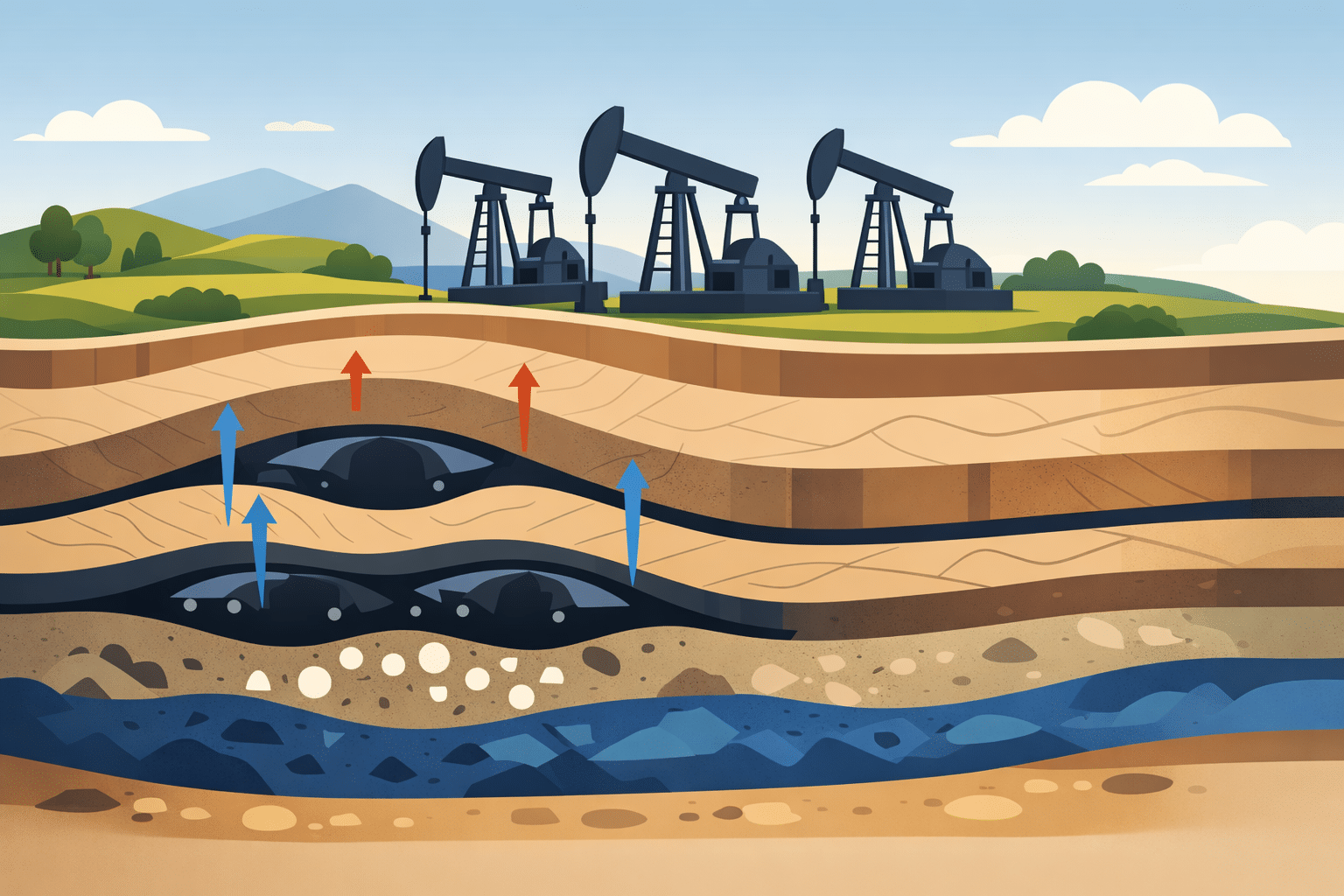
An oil and gas basin is one of the most important concepts in petroleum geology, yet it is often explained too briefly or too loosely. In practical terms, it refers to a broad geologic area where thick layers of sediment accumulated over immense spans of time, creating the conditions needed for oil and natural gas to form, migrate, and collect. When people talk about places like the Permian Basin, the Williston Basin, or the Anadarko Basin, they are talking about large geologic systems that help determine where exploration happens, how reservoirs are found, and why some regions become major producing areas.
Understanding the meaning of an oil and gas basin helps readers make better sense of industry news, mineral-rights conversations, lease activity, reserve discussions, and production trends. It also helps separate general geography from petroleum geology. A basin is not simply a low spot on a map. In the energy context, it is a geologic framework that may contain source rock, reservoir rock, seals, traps, and multiple petroleum systems working together over geologic time.
⚠️ IMPORTANT LEGAL DISCLAIMER:The information provided on this page is for general informational purposes only and does not constitute legal, financial, or investment advice. Oil and gas laws, mineral rights regulations, and royalty structures vary significantly by state and jurisdiction. While we strive to provide accurate and up-to-date information, no guarantee is made to that effect, and laws may have changed since publication.You should consult with a licensed attorney specializing in oil and gas law in your jurisdiction, a qualified financial advisor, or other appropriate professionals before making any decisions based on this material. Neither the author nor the publisher assumes any liability for actions taken in reliance upon the information contained herein.
Key Takeaways
- An oil and gas basin is usually a sedimentary basin where long-term subsidence created space for sediments to accumulate and later support petroleum generation and trapping.
- A basin does not become productive just because it exists. Commercial output depends on source rocks, burial history, reservoir quality, trapping, infrastructure, economics, and access to markets.
- A structural basin (oil and gas) is only one way geologists describe basin architecture. In petroleum work, understanding the full basin history matters more than using a single broad label.
- The idea of a super basin in petroleum geology refers to exceptionally prolific basins with large cumulative production, major remaining resource potential, stacked pay, infrastructure, and multiple petroleum systems.
- The Permian Basin is frequently discussed as a leading modern example because of its stacked reservoirs, scale, infrastructure, and long development history.
If you are trying to understand how basin quality may affect leasing, development activity, or long-term asset interest, you can contact our team for general information about oil and gas opportunities and transactions.
What Is an Oil and Gas Basin?
An oil and gas basin is a large geologic area where the Earth’s crust subsided over time and was filled with sediments such as sand, mud, silt, carbonates, and organic material. As those sediments were buried deeper, pressure, temperature, and chemical processes transformed parts of that geologic package into source rock, reservoir rock, and seals. Under the right conditions, hydrocarbons were generated, migrated through the subsurface, and became trapped in commercially significant accumulations.
This is why the term sedimentary basin is so important. Most oil and gas accumulations are associated with sedimentary rocks, not with large bodies of igneous or metamorphic rock. In other words, when petroleum geologists study an oil and gas basin, they are looking at the basin as a system: where the organic material came from, how it matured, where fluids moved, what rocks can store hydrocarbons, and what geologic barriers prevented those hydrocarbons from escaping.
A simple way to think about it is this: a basin is not just a container. It is an evolving geologic system. The shape of the basin matters, but its burial history, tectonic events, rock properties, fluid migration pathways, and timing relationships matter even more.
Why Basins Matter in Petroleum Geology
Basins matter because they organize how geologists evaluate petroleum potential. When a company studies a region, it does not begin with an individual well alone. It begins with the larger basin framework. That broader view helps answer questions such as:
- Is there an effective source rock?
- Did that source rock reach thermal maturity?
- Are there porous and permeable reservoir intervals?
- Are there seals strong enough to trap oil and gas?
- Did traps form before or during hydrocarbon migration?
- Is there enough thickness, pressure, continuity, and infrastructure to support development?
Those questions explain why two basins of similar size may have very different outcomes. One oil and gas basin may contain several productive intervals and decades of drilling inventory, while another may be geologically interesting but commercially limited. Basin size alone does not guarantee production.
That distinction is especially useful for anyone reading about oil and gas royalties, reserve estimates, or exploration trends. A productive basin can support multiple plays and multiple generations of development, while a less favorable basin may never attract the same level of capital or operational attention.
How a Sedimentary Basin Forms
A sedimentary basin forms when part of the crust subsides and creates accommodation space for sediments to accumulate. That subsidence may happen for several reasons, including rifting, flexure, crustal loading, thermal cooling, strike-slip motion, or other tectonic processes. Over geologic time, rivers, deltas, shallow seas, deepwater systems, wind, and chemical deposition fill the basin with layers of sediment.
As burial continues, those sediments compact and lithify into rock. Organic-rich layers may become source rocks. Sandstones, limestones, dolostones, and other units may become reservoirs if they retain enough porosity and permeability. Shales, evaporites, and dense carbonate intervals may act as seals. Faulting, folding, salt movement, stratigraphic pinch-outs, and other structural or stratigraphic changes may create traps.
Because of this, the phrase sedimentary basin is more than a label. It signals the presence of a geologic setting where the full petroleum system can develop. In many cases, multiple source intervals, multiple reservoirs, and multiple seal pairs stack vertically through the basin, creating repeated opportunities for hydrocarbon accumulation.
Key Elements Geologists Look For
- Source rock: Rock rich in organic matter that can generate hydrocarbons when heated through burial.
- Reservoir rock: Rock with enough pore space and connectivity to store and transmit fluids.
- Seal: A low-permeability barrier that prevents hydrocarbons from escaping upward.
- Trap: A geologic configuration that allows hydrocarbons to accumulate.
- Timing: The relationship between generation, migration, trap formation, and preservation.
These elements explain why basin analysis sits at the core of petroleum geology. An oil and gas basin is valuable not because it is merely deep or wide, but because it has the right combination of ingredients and geologic timing.
Types of Basins: Geographic Meaning vs. Petroleum Meaning
One of the biggest problems with many glossary definitions is that they mix ordinary geography with petroleum geology in a way that can confuse readers. In everyday language, people may hear about drainage basins, ocean basins, and landforms described as basins. In petroleum work, however, the more useful idea is the sedimentary basin that holds the rock record of burial, maturation, migration, and trapping.
That does not mean geographic terms are wrong. It simply means they are not equally useful for explaining petroleum systems. A drainage basin describes how water flows across the surface. An ocean basin describes a broad seafloor region. Neither definition, by itself, explains whether a region is a productive oil and gas basin.
Structural Basin (Oil and Gas) Explained
The phrase structural basin (oil and gas) usually refers to a basin geometry influenced by tectonic deformation, such as downwarping, faulting, flexure, or subsidence. Structural style can strongly influence where source rocks were preserved, where reservoirs developed, and where traps formed. However, petroleum professionals usually go beyond the simple phrase “structural basin” and ask a more complete set of questions about depositional history, burial depth, thermal maturity, seal effectiveness, and migration pathways.
So while a structural basin (oil and gas) can be a useful term, it should not be treated as a complete explanation for petroleum potential. A structurally formed depression may still be poor for hydrocarbons if it lacks organic richness, sufficient maturation, effective trapping, or economic recoverability. Conversely, a basin with complex structural history may be highly productive if the petroleum system elements line up well.
This broader explanation helps readers avoid a common misunderstanding: not every structural low is automatically a commercial petroleum province, and not every productive basin can be understood through structure alone.
What Makes One Basin More Productive Than Another?
Production differences from one basin to another usually reflect a mix of geology, engineering, market access, and timing. Some basins have thick organic-rich intervals, multiple reservoir targets, favorable pressure, and long-lived infrastructure. Others may have one or more missing ingredients. The strongest basins often combine geologic quality with practical development advantages.
Key factors include:
- Organic richness and quality of source rock
- Thermal maturity and burial history
- Reservoir thickness, continuity, porosity, and permeability
- Trap quality and seal integrity
- Stacked pay potential across multiple intervals
- Existing pipelines, roads, power, water, and services
- Commodity prices and development economics
- Regulatory framework and access to capital
These factors help explain why the same basin can also change over time. New seismic data, horizontal drilling, hydraulic fracturing, improved completions, better geologic modeling, and stronger takeaway capacity can all reshape how an oil and gas basin is valued and developed.
For readers trying to connect geology with value, this is also why basin context matters when comparing topics such as average price per acre for mineral rights or the likelihood of future leasing and drilling. Geology does not determine every outcome, but basin quality often sets the ceiling for what is realistically possible.
From Basin to Field to Reservoir
Another source of confusion is the difference between a basin, a field, and a reservoir. These terms are related, but they are not interchangeable.
- Basin: The large regional geologic framework that contains sedimentary fill and one or more petroleum systems.
- Field: A discovered accumulation area where one or more wells produce hydrocarbons from related reservoirs.
- Reservoir: A specific porous and permeable rock unit or interval capable of storing and producing hydrocarbons.
A single oil and gas basin may contain many fields, and a single field may contain multiple reservoirs. That hierarchy matters when reading industry articles. Reports about basin activity usually describe a regional trend. Reports about a field may be more localized. Reports about a reservoir interval may refer to one target zone within a broader development program.
If you are sorting through basin descriptions, lease offers, or development maps and need help understanding how the regional geology may connect to transactions or ownership questions, you can reach out through our contact page for more information.
Why the Permian Basin Is So Often Mentioned
The Permian Basin is one of the most frequently cited U.S. examples because it illustrates how a mature basin can remain highly relevant through changing technology and economics. It is known for extensive development history, multiple producing intervals, large existing infrastructure networks, and stacked reservoirs that support repeated drilling programs across a broad region.
That does not mean every acre in a major basin has equal value or equal development prospects. Basin reputation is not the same as property-specific potential. Even within a famous oil and gas basin, geology, depth, well control, operator plans, lease status, and infrastructure access can vary substantially from one area to another.
This is the practical side of basin analysis: a basin can be world-class overall while still containing areas with very different economics and drilling outlooks.
What Is a Super Basin in Petroleum Geology?
The phrase super basin in petroleum geology is used to describe exceptionally prolific basins that combine very large cumulative production with major remaining resource potential and durable development advantages. The term gained attention because it helps distinguish ordinary producing basins from the rare basins that can continue generating large volumes and attracting investment across multiple development cycles.
In common industry usage, a super basin in petroleum geology is associated with several traits:
- Large cumulative historical production
- Significant remaining recoverable resource potential
- More than one petroleum system or source-rock interval
- Stacked reservoirs or repeated target intervals
- Established oilfield services and takeaway infrastructure
- Strong access to markets and continued technical innovation
The concept matters because it shifts the discussion from isolated wells to basin-scale durability. A basin may be attractive not only because it has produced a lot in the past, but because it still offers repeatable development opportunities and a large supporting ecosystem. That is one reason the Permian is so often discussed in connection with the idea of a super basin in petroleum geology.
Why the Super Basin Concept Matters
The super-basin framework highlights an important truth: scale alone is not enough. A basin becomes unusually durable when geologic richness is paired with infrastructure, market access, service capacity, data density, and technology that can unlock new zones over time. That makes the concept useful for understanding why some areas stay active across decades, even as drilling methods, price cycles, and corporate strategies change.
It also creates a more nuanced way to discuss basin quality. Instead of saying a basin is “big,” the super-basin idea asks whether it has repeatability, stacked inventory, petroleum-system diversity, and commercial resilience.
Common Misunderstandings About the Oil and Gas Basin Concept
Misunderstanding 1: Every Basin Produces Oil and Gas
Not every basin is productive. Some sedimentary basins lack one or more critical petroleum-system elements, while others remain underexplored or are not economic under current conditions.
Misunderstanding 2: Basin Size Guarantees Value
Large size can help, but commercial value depends on much more than area. Rock quality, maturity, pressure, trap style, infrastructure, and economics all influence whether a basin supports sustained development.
Misunderstanding 3: “Structural Basin” Tells the Whole Story
A structural basin (oil and gas) description may explain part of the basin geometry, but it does not replace full petroleum-system analysis.
Misunderstanding 4: Basin Reputation Applies Equally Everywhere
Even in a famous basin, local variation can be significant. Some areas are heavily drilled and highly economic; others may be less proven, less accessible, or less commercial.
How Basin Knowledge Helps in Real-World Decisions
Understanding the meaning of an oil and gas basin can improve how people interpret lease activity, drilling news, production data, and valuation discussions. Basin context helps answer practical questions such as:
- Why are operators active in one county but not another?
- Why do some areas support multiple formations and stacked development?
- Why can transaction values vary so widely between regions?
- Why do some basins attract long-term infrastructure buildout?
This kind of context is especially useful when reading related topics such as how to get oil companies to drill on your land, because operator interest is tied to geology, economics, and development priorities within the broader basin framework.
It is also useful when comparing ownership and transaction questions. Someone evaluating minerals in an established producing area may be dealing with a very different set of facts than someone in an early-stage or lightly developed region, even if both properties technically sit inside the same named basin.
Oil and Gas Basin vs. Province, Play, and Prospect
To understand industry language more clearly, it helps to distinguish a basin from several nearby terms:
- Province: A broader geologic region that may include one or more basins or petroleum systems.
- Play: A set of geologically similar exploration or development targets sharing common source, reservoir, seal, and trap characteristics.
- Prospect: A specific drillable target identified for exploration.
These terms sit at different scales. The oil and gas basin provides the regional framework. Within that framework, geologists identify plays, and within those plays, companies define prospects. Keeping those terms separate improves clarity and helps readers follow technical discussions more easily.
How to Read Basin Discussions More Accurately
When you see an article or report discussing a basin, look for details that go beyond the basin name. Useful questions include:
- Which formations or benches are being discussed?
- Is the focus conventional, unconventional, or both?
- What stage of development is the area in?
- Are there multiple stacked targets?
- How developed is the infrastructure?
- What does the basin history suggest about long-term activity?
Those questions can turn a broad basin reference into something much more informative. They also help connect the geologic language of a sedimentary basin or a structural basin (oil and gas) with the business realities people encounter in leases, royalty statements, acquisitions, and market reports.
Frequently Asked Questions About Oil and Gas Basins
Is an oil and gas basin the same thing as an oil field?
No. An oil and gas basin is a large regional geologic system, while an oil field is a more specific producing area within that larger system.
Why is a sedimentary basin important for hydrocarbons?
A sedimentary basin provides the conditions for organic matter burial, source-rock development, reservoir deposition, sealing, and hydrocarbon trapping. Those are the essential ingredients of most petroleum systems.
What does structural basin mean in oil and gas?
A structural basin (oil and gas) usually refers to a subsiding or downwarped geologic area shaped by tectonic forces. It can be an important part of petroleum analysis, but it is only one part of the full basin story.
What is a super basin in petroleum geology?
A super basin in petroleum geology is an unusually prolific basin with major cumulative production, significant remaining resource potential, stacked pay, multiple petroleum systems, infrastructure, and market access.
Does being in a named basin guarantee drilling or production?
No. Being inside a named basin does not guarantee that every tract or interval is equally prospective or economic. Local geology, development history, operator plans, and infrastructure all matter.
Conclusion
The term oil and gas basin refers to far more than a simple geographic depression. In petroleum geology, it describes a large subsurface system where sediment accumulated, rocks matured, hydrocarbons formed, and commercial accumulations may be preserved. Understanding the basin framework helps explain why some regions become major producing centers and why others remain less active.
It also helps clarify related terms such as sedimentary basin, structural basin (oil and gas), and super basin in petroleum geology. Each term adds a layer of meaning, but the central idea remains the same: basin-scale geology shapes petroleum potential, development patterns, and long-term relevance in the oil and gas industry.
Whether you are trying to understand industry terminology, evaluate activity in a region, or connect basin geology with ownership and transaction questions, a clear grasp of the oil and gas basin concept is a useful place to start. To discuss available opportunities or get more information, contact our team today.